Showing posts with label dharma class. Show all posts

5/12/2009

Conclusion of Sutra of the Forty-Two Chapters


Sutra of the Forty-Two Chapters class came to a conclusion on May 3rd. Several impressive records were set during this nine-class semester. For example, class location had to be changed to accommodate the large number of attendees. On average, the number of weekly attendees exceeded 36. At the end of the term, 28 people received a certificate of completion while 18 students attended all classes.

May 3rd coincidently was also Shifu’s birthday. Current and past students gathered and gave him a surprise birthday party. Shifu expressed his deepest appreciation to both Venerable Jin Hai and Venerable Hung I, and all the students and supporters for the past two years. He was especially grateful of the encouragement and opportunities granted by the two Venerables. Because of their trust and support, he was able to continue his study for the past two years while offering classes at Jade Buddha Temple. Similarity, students were thankful that Shiful would share his teachings while juggling with busy academic schedules. Everyone wished him to complete his degree soon.

Graduation ceremony was held the following week. Venerable Jin Hai and Venerable Hung I were present to give the awards. Eighteen students who maintained a perfect attendance received a black sandalwood wooden fish, completed with a golden-stringed cotton pad. Shifu joked that the unprecedented high level of full attendance must due to everyone’s desire to receive this gift. This phenomenon reflected what the sutra said, “give them what they desire to attract them in, then teach them the dharma.”


After the ceremony, some students shared their reflections. Here are some selected contents:

Student1: This was my first dharma class. I hope I can continue.

Student2: I had never stepped into a temple, let alone taking dharma class. Being a Christian for 40 years, I continued to struggle with things in life and were unable to find an answer. A friend introduced me to this class. I thought I would take it as a philosophy class. However, this class was like a door to a new world. Even though I have not taken the refuge, I have started to think deeper and wilder. I hope I can continue to take Shifu’s class.

Student 3: I am ashamed to say that I have been coming to the temple for many years; however, this was my first dharma class. I was so blessed to be able to attend this class and I have benefited greatly.

Student4: This was my second time taking Shifu’s class. However, my husband challenged me: how come you are leaning the dharma yet you have not yet changed your temper? There are still rooms for improvement!

Student5: I particularly liked how Shufu always pulled us back to focus on the cultivation of our mind. This method can be easily applied to my daily life and I have received great benefits.

Student6: This was my first dharma class. Shiful pointed out in the first class some common pitfalls we parents share today. He advised us to create a positive relationship with our children and respect their own development. At times, we should learn to let go and try not to always make decisions for them from our own angles. My daughter asked me about the class when I returned home. Upon hearing what Shiful said, she eagerly encouraged me to continue taking the class.


Student7: what stayed with me the most is what Shifu asked: what is true happiness: away from suffering is true happiness.

Student8: I have been to the temple for over 20 years and my first dharma class was with Shifu. In the past two years, except for one time I was sick, I have never missed a class. In order to succeed in Shifu’s classes, I began to pick up books and dictionary again. Unfortunately my memory is not as sharp as before, so I can only continue to attend class to make up my own shortcomings.

Student9: I feel I still have yet learned enough. This was my third semester. I was clueless in the first semester. Second semester was a little better. This semester was the best because Shifu’s skillful way of designing the homework. It forced us to read the sutra and review the handout. I often stayed up pass midnight for homework. Two-hour class was too short. I hope Shifu will return soon so we can take more classes.

Student10: I attended Christen schools and requested that my husband accept Jesus before I would marry him. Because my father passed away last year, I came in contact with the temple then. Thank to Shifu’s class, I realized my own misunderstanding about Buddhism and finally had the chance to uncover the real Buddhism. My husband was especially looking forward to the weekly class.

Student11: After two semesters, I can now apply Buddhism in my daily life. I used to change job every other year because I seemed to be able to find faults in everything. After these classes, I began to see people, things, and events with a different light. As a result, I felt more at ease.

A farewell party for Shifu was held the next day at Sweet Tomato.

2/15/2009

New Class - Sutra of the Forty-Two Chapters


The Sutra of Forty-two Chapters (四十二章經) is the very first Buddhist sutra to be translated into Chinese. During emperor Ming of Han, Kasyapa-Matanga (迦葉摩騰) and Dharmaraksha (竺法蘭), two Buddhist monks from India, brought to China many sutras, Buddha relics, and Buddha paintings, reportedly on the back of a white horse. When they reached the Chinese capital of Luoyang, the emperor built the White Horse Temple for them. This was the very first Buddhist temple built in China. The emperor also requested that they translate the sutra into Chinese.

The Sutra of Forty-two Chapters consists of largely quotations from the Buddha. It is believed that these quotations were systematically selected and compiled by Buddha’s disciples after Buddha passed away and entail all major teachings of both Mahayana and Theravada Buddhism.

Master Jian Dan carefully categorizes the forty-two chapters and selectively chooses sections that are more suitable for contemporary livings. Combining with real-life examples, Master skillfully explains the meanings of the sutra to realize Buddhism in everyday life.

Due to the overwhelmingly large audience, the class has to be moved to a larger classroom to accommodate everyone. Students always enjoy and appreciate Master’s humor and lively interactions.

12/16/2008

Conclusion of Fall Semester –Boddhisattva’s Practices

Fall semester’s class on Boddhisattva’s Practices ended on December 14th. It was a time to congratulate all dharma brothers and sisters for the completion of yet another semester of assiduous studying of Buddhism. It was also a time of renewing our vows and following the Boddhisattva’s path to benefit self and all sentinel beings.

This semester, Master spent a great deal in discussing each of the six paramitas (giving, virtue, tolerance, diligence, concentration and insight). Master emphasized the multi-facet understanding of each paramita and the practical ways to implement them in our everyday lives. Master’s teaching was well received, as evident by an impressive record of attendance. Nineteen (19) attendees attended eight (8) or more classes and received a certificate of completion. In addition, nine (9) attendees managed to attend all classes. Those with perfect attendance received a special rosary from the Master as an encouragement to their diligence.

Shortly after the certificate ceremony, the group moved to a newly opened coffee shop to continue the dharma discussion and celebration. Over 60 people gathered, including family members, children and new born babies. All students earnestly request to hear the spring class schedule soon.

12/10/2008

Growing a good mind: an experiment

From late November to early December, Master held a series of special “experiment” with Bodhi Chinese School children about “growing a good mind.” The purpose of this experiment is to demonstrate the power of words. Using green beans as the experiment subjects, we test saying good words and bad words to them while growing them.

As always, to make any activity meaningful and successful, before Master’s visit to the classrooms, the school sent a letter home. In the letter, the school stressed how parents’ continued involvement is essential in any learning activity. As such, Master asked that parents come to both classes and be active in helping their children throughout this experiment. Together with the letter is an instruction sheet detailing the experiment procedures, which will be carried out at home with parental assistance.

Grade Level: 3rd grade (can be adjusted to fit all levels)

Key concept: Our mind can create positive energy
Title: Growing a Good Mind: An Experiment

Objectives: Students are able to
  1. relate the experiment results to daily interactions with others
  2. practice setting good intentions and using good words

Description: A two-class series about how important it is to set positive intentions and interact with others using positive words. Students, with the help from parents, grow green beans for two weeks at home. Students and their parents say good words to one cup of beans and bad words to another cup of beans for two weeks. At the end of the 2-week period, students bring back their experiments, discuss in class the findings and what it means to them.


Class 1 Anticipatory set:
  1. Story: Nails, Nails on the Wall: a story about how anger (bad words) leaves permanent scars and are hurtful to others and self.
  2. Interactive Questions: use questions from story to bring students to identify the power of words and how easy we can practice saying good words every day.

Class 1 Procedure (details omitted here)
At the end of the story and class time, ask students to predict what will happen to the beans.

Class 2 closure activity
After students examine each other’s experiments, compare, contrast, and discuss the reasons, play the game “thinking positively”

For example: On my way to school today, I realized that I lost the 5 dollars I put in my pocket… Now think positively …what would you say? 1) Thank goodness I did not lost 10 dollars or 2) Whoever finds it must be very happy

Another example: I studied very hard but still did not do well on the Chinese quiz. Now think positively … what would you say? 1) Thank goodness it is not the final examine or 2) I will have so much room for improvement

Each Chinese class’s homeroom teacher gives out Chinese-related homework based on this experiment.

Overall, students were engaged and enthusiastic about this experiment. One student even brought his beans to his American school every day, just to show off his experiment! Even though the end results did vary (while mostly favored the good-word group), students were able to relate the power of intentions and words into daily interactions.

The school has asked the Master to give another lesson next semester.

5/27/2008

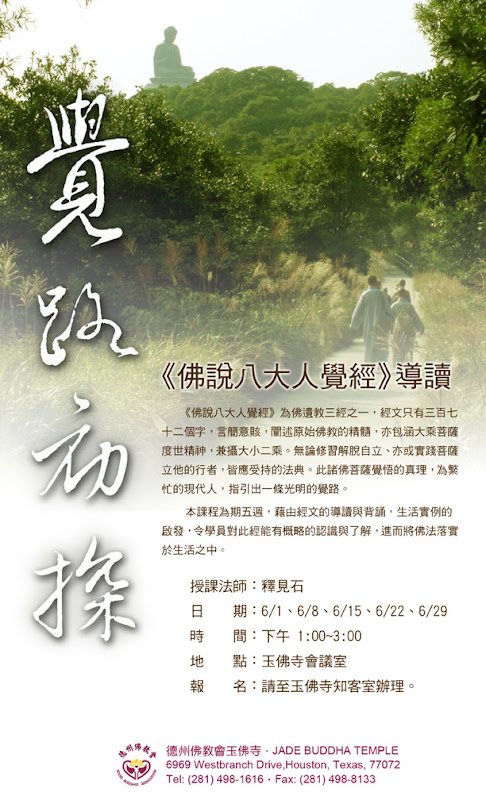
New Class - The Eight Great Awakenings Sutra (in Chinese)

As one of the earlier translation of Chinese sutras, the Eight Great Awakenings Sutra has only 372 words and is one of the shortest and most concise Buddhist sutras. This sutra has been dedicated to lay followers before Buddha’s attainment of Nirvana. Many regard this Sutra to encompass Buddha’s fundamental teachings preached during his lifetime. It has similar characters as the Sutra of Forty-two Sections and the Testament Sutra, which are particularly sacred to monastic disciples. This sutra is entirely in accord with both the Mahayana and Theravada traditions where the texts address both the way to self realization as well as the path of Bodhisattva.

If Buddhist disciples recite this Sutra on the Eight Awakenings, and constantly ponder its meaning, they will certainly eradicate boundless offenses, advance towards Bodhihood, and will quickly realize Proper Enlightenment. They will always be free of birth and death, and will abide in eternal bliss – The Eight Great Awakenings Sutra

The above excerpt is the conclusion of the Sutra. It emphasizes the importance of putting the eight awakenings into practice in order to attain the benefit of Enlightenment. Only reciting the Sutra is just like a parrot that imitates human speaking, without knowing the real meaning. In this new five-week class, through recitation, discussion, and dharma talk given by Master Jian Dan, participants will gain deep understanding of the eight awakenings practiced by all Buddhas, Bodhisattvas, and Buddhist followers.

Date: Sundays (June 1 – June 29)

Time: 1:00 – 3:00pm

Location: Meeting room @ Jade Buddha Temple

Registration: Contact temple office

5/26/2008

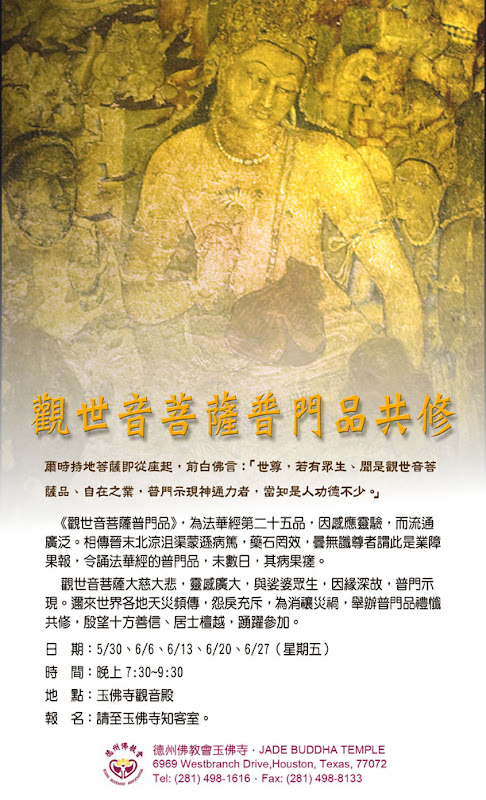
Dharma Assembly: Universal Door Chapter (in Chinese)

At that time the Bodhisattva Guardian of the Earth rose from his seat and said to the Buddha, "World Honored One, if there are those who hear this chapter of Guanshiyin Bodhisattva, who learn about the self-mastery of his deeds and the power of his spiritual penetrations as shown in this Universal Door, you should know that the merit and virtue of such people will not be small."

The above excerpt came from chapter 24 of the Lotus Sutra. Containing 28 chapters in total, Lotus Sutra is one of the earlier Mahayana Buddhist texts. Widely regarded as a Buddhism classic of great beauty and power, Lotus Sutra also represents one of the most important and popular texts in the Mahayana tradition, a form of Buddhism predominant in East Asia. Chapter 24, titled Universal Door, focuses on the spiritual powers and miraculous functions of the inconceivable state of Guanshiying Bodhisattva, the Bodhisattva who Contemplates the Sounds of the World. It is believed that if we recite this chapter in great concentration and sincerity, we can experience this inconceivable and miraculous power ourselves.

Master Jian Dan will lead a five-week dharma assembly, reciting the Universal Door Chapter. In addition to chanting and prostration, Master will give brief dharma talks on this chapter.

Date: Fridays (May 30 – June 27)

Time: 7:30 – 9:30 pm

Place: Guan Yin Hall, Jade Buddha Temple

Registration: Contact temple office

1/15/2008

Intermediate Dharma class at Jade Buddha Temple

I will be teaching one weekly class about basic concepts of Buddhism at Jade Buddha Temple starting January. The class is offered on Sunday afternoons from 1:00 to 2:30. We use the book “The way to Buddhahood” by Venerable Yin-Shun as the framework to discuss various basic Buddhism concepts. This is a combined class with students from last semester's Friday night and Sunday afternoon classes. We finished chapter 1 to 3 of "The way to Buddhahood" and will continue from chapter 4. About half of the students will repeat chapter 4 one more time. The feedback I received from those students indicated that chapter 4 might be a little less organized and some of the concepts are mixed together. I will need to find different ways to convey those concepts.

8/01/2007

Two new Dharma classes at Jade Buddha Temple

Since my last weekly Dharma classes at Jade Buddha Temple were well received, I was asked to lead two new Dharma courses this Fall. One intermediate course will be the continuation from last class. In the previous class, we finished chapter 1 to 3 of “The way to Buddhahood.” In this term, we will continue to discuss chapter 4. In addition to this intermediate class, I was also asked to offer the same beginning class for members who had not had a chance to take the previous class. Again, in the beginning class, we will cover chapter 1 to 3 from the book. The intermediate class will continue to be offered at the same time, weekly on Sundays from 1:00 to 2:30. The new beginning class will be offered weekly on Fridays from 7:30 pm to 9:00 pm.

Beginning class – Fridays – 7:30 – 9:00 pm – Chapter 1 to 3

Intermediate class – Sundays – 1:00 – 2:30 pm – Chapter 4

I certainly appreciate this great opportunity to offer Dharma talks, to discuss Buddhism, and to get to know the members better. As a monk, spreading Buddhism is my duty. However, I do worry if I will be able to do a good job taking on two courses at the same time. All I know is I definitely will try my best in leading these two classes.

2/25/2007

Dharma Discussion Class at Jade Buddha Temple

Starting in February 25, I have been teaching one weekly class about basic concepts of Buddhism at Jade Buddha Temple. The class is offered on Sunday afternoons from 1:00 to 2:30. We use the book “The way to Buddhahood” by Venerable Yin-Shun as the framework to discuss various basic Buddhism concepts. Initially I was told to design this class for younger members. However, among 30 members who have been attending regularly, most of them are middle aged. It appears that they still accept my way of teaching. I really respect their learning attitude.