7/29/2009

Study Abroad China - Summer 2009

During the month of July, Ven Jian Dan visited China with the study abroad program with the University of Houston. During this study trip, he had the chance to visit several well-known temples in Shanghai and Beijing. He also had the privilege to meet with several authorities and discussed Buddhism’s development and local differences between the east and the west. Ven Jian Dan also spent time meeting with local lay Buddhists, offering lectures and facilitating discussions.

Shanghai JadeBuddha Temple (上海玉佛寺). Picture taken in front of the grand hall.

Shanghai Jing’an Temple (上海靜安寺). Picture taken in front of the grand hall.


Shanghai Longhua Temple (上海龍華古寺) Picture taken in front of the grand hall.

Shanghai Pupu Bridge with study aborad student.

Picture taken in front of the Oriental Pearl TV Tower

Picture taken in front of Beijing Hall of Supreme

5/12/2009

Conclusion of Sutra of the Forty-Two Chapters


Sutra of the Forty-Two Chapters class came to a conclusion on May 3rd. Several impressive records were set during this nine-class semester. For example, class location had to be changed to accommodate the large number of attendees. On average, the number of weekly attendees exceeded 36. At the end of the term, 28 people received a certificate of completion while 18 students attended all classes.

May 3rd coincidently was also Shifu’s birthday. Current and past students gathered and gave him a surprise birthday party. Shifu expressed his deepest appreciation to both Venerable Jin Hai and Venerable Hung I, and all the students and supporters for the past two years. He was especially grateful of the encouragement and opportunities granted by the two Venerables. Because of their trust and support, he was able to continue his study for the past two years while offering classes at Jade Buddha Temple. Similarity, students were thankful that Shiful would share his teachings while juggling with busy academic schedules. Everyone wished him to complete his degree soon.

Graduation ceremony was held the following week. Venerable Jin Hai and Venerable Hung I were present to give the awards. Eighteen students who maintained a perfect attendance received a black sandalwood wooden fish, completed with a golden-stringed cotton pad. Shifu joked that the unprecedented high level of full attendance must due to everyone’s desire to receive this gift. This phenomenon reflected what the sutra said, “give them what they desire to attract them in, then teach them the dharma.”


After the ceremony, some students shared their reflections. Here are some selected contents:

Student1: This was my first dharma class. I hope I can continue.

Student2: I had never stepped into a temple, let alone taking dharma class. Being a Christian for 40 years, I continued to struggle with things in life and were unable to find an answer. A friend introduced me to this class. I thought I would take it as a philosophy class. However, this class was like a door to a new world. Even though I have not taken the refuge, I have started to think deeper and wilder. I hope I can continue to take Shifu’s class.

Student 3: I am ashamed to say that I have been coming to the temple for many years; however, this was my first dharma class. I was so blessed to be able to attend this class and I have benefited greatly.

Student4: This was my second time taking Shifu’s class. However, my husband challenged me: how come you are leaning the dharma yet you have not yet changed your temper? There are still rooms for improvement!

Student5: I particularly liked how Shufu always pulled us back to focus on the cultivation of our mind. This method can be easily applied to my daily life and I have received great benefits.

Student6: This was my first dharma class. Shiful pointed out in the first class some common pitfalls we parents share today. He advised us to create a positive relationship with our children and respect their own development. At times, we should learn to let go and try not to always make decisions for them from our own angles. My daughter asked me about the class when I returned home. Upon hearing what Shiful said, she eagerly encouraged me to continue taking the class.


Student7: what stayed with me the most is what Shifu asked: what is true happiness: away from suffering is true happiness.

Student8: I have been to the temple for over 20 years and my first dharma class was with Shifu. In the past two years, except for one time I was sick, I have never missed a class. In order to succeed in Shifu’s classes, I began to pick up books and dictionary again. Unfortunately my memory is not as sharp as before, so I can only continue to attend class to make up my own shortcomings.

Student9: I feel I still have yet learned enough. This was my third semester. I was clueless in the first semester. Second semester was a little better. This semester was the best because Shifu’s skillful way of designing the homework. It forced us to read the sutra and review the handout. I often stayed up pass midnight for homework. Two-hour class was too short. I hope Shifu will return soon so we can take more classes.

Student10: I attended Christen schools and requested that my husband accept Jesus before I would marry him. Because my father passed away last year, I came in contact with the temple then. Thank to Shifu’s class, I realized my own misunderstanding about Buddhism and finally had the chance to uncover the real Buddhism. My husband was especially looking forward to the weekly class.

Student11: After two semesters, I can now apply Buddhism in my daily life. I used to change job every other year because I seemed to be able to find faults in everything. After these classes, I began to see people, things, and events with a different light. As a result, I felt more at ease.

A farewell party for Shifu was held the next day at Sweet Tomato.

4/04/2009

Meditation to Reduce Academic Stress

Location: Social Work Building #328, University of Houston

Date: Tuesday (3/31) & Thursday (4/2)

Time: 4:00pm – 5:00pm

Sponsor: Learning Support Services (http://www.las.uh.edu/lss/)

Due to popular demand, Master Jian Dan was invited back by University of Houston’s Learning Support Services to give two seminars on mediation and academic stress. Learning Support Services offers tutoring, learning strategies workshops, learning style assessments and other activities to support and increase student academic performance. Master was invited to teach students how to reduce academic stress through meditation practice.

Survey collected by Learning Support Services showed that students regarded this seminar a positive experience. One student commented, “the presenter was knowledgeable & entertaining,” while another wrote, “the topics is pretty interesting for me.” Students listed new skills they learned from “take a deep breath and count the number,” “meditation to concentrate,” “focus on only present situation,” to “trying to stop wondering thoughts.” So, how will the new learned skill help them academically? One student shared, “It would affect me greatly academically because I could reduce lots of stress.” Another student indicated that the new skill will help him or her more “easier to focus on assignments & exams w/o being distracted.” “Help me pay attention in class,” “be able to concentrate better and relax more”, and "better performance grades wise and career goal wise” were among other answers.

Integrating regular mediation sitting into daily routine undoubtedly requires certain level of commitment and motivation. Students who are interested in knowing more about mediation should go to a reputable mediation center and seek guidance from well-trained teachers.

3/28/2009

Integrating Chan into Your Life


Date: March 27, 2009 (Friday)
Time: 7:00-8:30pm
Location: University of Texas, Austin
Venue: Texas Union Asian Culture Room 4.224

Venerable introduced the difference between Chinese Chan and other Buddhist practices. He emphasized the application of Chan into day to day activities. Venerable borrowed stories from Chan koans to illustrate the skillful integration of Chan in daily life.

3/21/2009

AMZH @ Aloha - Beach Picnic with Chan Talk

Master’s Wednesday talk at the Chinese Pure Land Buddhist Association, Hawaii Chapter was so well received. As a result, members voluntarily organized a beach picnic Friday. The picnic was held at Honolulu’s famous Ala Moana beach park and over 50 to 60 people gathered. With delicious home-cooked food and beautiful Hawaii weather as companies, everyone sat under the shade to take the last chance to listen to Master’s teachings.

3/20/2009

AMZH @ Aloha - Spiritual Conversation with a Buddhist Monk


Spiritual Conversation is a student group initiated and organized by University of Hawaii students to have a safe place to discuss various religions. They often invite teachers from different faith traditions to share their perspectives and answer questions from people who do not share the same religion. Venerable Jian Dan was invited to offer his take on the unique teachings of Chinese Chan Buddhism.

Venerable pointed out that Chan originated in China and its teaching highlights the quest to uncover our original pure mind. For example, the concept of “dust” and “guest” from the Shurangama Sutra 《楞嚴經》can help illustrate this concept. Buddhist’s quest is to realize what/who is the dust and guest. Guests are those coming and going in a hotel while the owner is the real host. We should observe the impermanence of the world, and recognize that all phenomena are dust and guest where they appear and fade away. This way, we will not waste our lives on pursuing mirage (dust/guest) but to uncover our true host – our pure mind.

Among the attendees were trained teacher in Japanese True Pureland, scholar in Japanese Buddhism, and many other students with different faith traditions. After the detailed and lively talk, many people stayed and took this rare opportunity to ask more questions.

3/19/2009

AMZH @ Aloha - Chan & Pure Land

Date: March 18 (Wednesday)
Time: 7:00 - 9:00 pm
Location: Chinatown, N Hotel St & Kekaulike St, Honolulu, HI 96817
Sponsor: Chinese Pure Land Buddhist Association, Hawaii Chapter

Chinese Chan Buddhism highlights how an enlightened mind sees the nature(明心見性)。On the other hand, Chinese Pure Land Buddhism emphasizes when the inner flower blossoms, one sees the Buddha (花開見佛) 。In reality, these two represent identical meaning: seeing one’s true nature is seeing one’s Buddha nature. Therefore, practicing Chan is the same as practicing Pure Land, even though Chan does emphasize more on the causes while Pure Land pays more attention to the results. Nonetheless, these two practices point to the same path. In this interactive talk, Venerable Jian Dan explained the two practices and encouraged all practitioners to purify one’s mind to attend Pure Land.

3/18/2009

AMZH @ Aloha - Meditation & Inner Peace

Date: March 18
Time: 1:30 – 2:30 pm
Location: University of Hawaii at Manoa, REL 475 Seminar on Buddhism class

Venerable Dr. Mun is a Korean monk and a visiting scholar to University of Hawaii at Manon. He offers classes about Buddhism at the department of philosophy and religion. When he received the news about Venerable Jian Dan’s visit, he eagerly invited Venerable Jian Dan to give a talk at his undergraduate seminar class. This semester, this seminar class focuses on the investigation of Buddhism in peace. Based on this idea, Venerable Jian Dan was asked to teach basic meditation techniques and addresses the relationship between meditation and individual inner peace.

Venerable taught basic breath counting method and let the students practice twice. After the short meditation practices, students expressed the difficulty of focusing on the breath. Many indicated that their minds wondered around and were unable to concentrate. Venerable Jian Dan pointed out that we are habitual beings who are used to allow our wondering thoughts control us. We follow our thoughts everywhere but here. Most of the time, we are not even aware that out thoughts have gone a thousand miles away. By relying on counting the breath, we can gradually train our mind to be more aware, more concentrated and therefore more peaceful.

Venerable stressed at the end that peace is not something external for us to seek. Inner peace is already in our Buddha nature. All we need to do is to uncover it within.

3/17/2009

AMZH @ Aloha - Dharma Talk at Fo Guang Shan

Date: March 17, 2007
Time: 10am – noon
Location: Fo Guang Shan Hawaii Center@ Chinese Culture Plaza
The Abbot of Fo Guang Shan Hawaii Center, Venerable Yi Hong, was generous enough to give their regularly scheduled book club meeting time to Venerable Jian Dan for a dharma talk. Venerable Jian Dan used some frequently used Chinese idioms to illustrate some Buddhist concepts. Interestingly, many of these Chinese idioms were originally from Buddhist text. However, over the years, their meanings have changed. For example, tian hua luan zhui (天花亂墜) means smooth talking that stretches the truth. However, from the Buddhist text, it means heavenly beings are so joyful after hearing Buddha’s teaching, they drop flowers from heaven to express their appreciation.

After a short and humorous talk, attendees started to ask questions. For example, one person asked, if Buddhism talks about cause and effect and stresses that we are always the receiver of our own action, no one else could take our consequences away from us, then why when America made a big mistake and dug a big financial hole that caused economical crisis, the rest of the world has to suffer with America? In other words, America created the cause but everyone else suffers the effects? Venerable quickly pointed that there are at least two kinds of karma – individual karma (別業) and collective karma (共業). Countries that have a close economic tie to America share the collective karma, therefore suffer when the entire economy changes. However, not all countries or all companies are losing money under current situation. They have individual karma that separates them from America, therefore can avoid been affected by the economy.

After the talk, Venerable stayed for some delicious homemade vegetarian meals. Another visiting Buddhist nun, Venerable Yi Fa, also joined for lunch. During lunch, Abbot introduced both Venerables and praised Venerable Jian Dan for his right view, sharp concepts, and skillful presentations.

Many members gathered around Venerable Jian Dan after lunch and continued to seize the opportunity to ask more questions. Most of them commended on his talk and was eager to see him visit Hawaii again.

3/16/2009

AMZH @ Aloha - Temple Visits

While in Hawaii, Venerable Jian Dan took the time to visit a couple of local temples.

Venerable Yi Hong, Abbot of Fo Guang Shan Hawaii Center, and members welcomed Venerable Jian Dan for his visit to the center

Venerable Jian Dan visited Guan Yin Temple, a traditional Chinese temple of over 100 years old. Abbot of Guan Yin Temple, Venerable Hong En, encouraged Venerable Jian Dan to visit Hawaii again.

Venerable Jian Dan visited Xu Yuan Temple, a 40-year temple in Honolulu. Venerable is in the lineage of Master Xu Yuan (empty cloud)

Venerable visited a Korean Temple called Dae Won Sa Buddhist Temple of Hawaii. It is said that this temple is the largest Korean temple outside of Korea

3/15/2009

AMZH @ Aloha - From Chinese Idioms to Learning about Buddhism

Date: March 13 (Friday)
Time: 3:30 - 5:30 pm
Location: Wist 115 (University of Hawaii @ Manoa - College of Education)
Sponsors: Center for Chinese Studies

Buddhism came into China as a foreign religion, yet it not only flourished in China, Buddhism also deeply integrated into the Chinese culture. For example, Buddhism impacted significantly on Chinese literary styles by introducing new imaginary concepts, terminologies, and narrative styles. Many everyday Chinese idioms are from Buddhist texts and Chan stories. In this interactive and humorous talk, Venerable Jian Dan, a visiting Buddhist monk from Houston, Texas, deciphered some deepest Buddhism concepts using everyday Chinese idioms.

Participants asked many practical questions after the talk. One professor from social work shared her reflection afterward, "it was a very interesting talk that I really enjoyed. The teacher is not a old monk we usually have in our mind. He is a young, funny, and intelligent teacher. I am glad we will all go to meet him and listen to his talk."

Venerable gave blessings to those who wish to receive by giving them a rosary. Several people indicated that they will also attend Venerable's upcoming talk in China Town.

3/14/2009

AMZH @ Aloha - Meditation on Encounter Dialogues: At the Core of the Chan Tradition

Location: Sakamaki Hall A302 (University of Hawaii @ Manoa - Department of Religion)
Date: March 13 (Friday)
Time: 1:00 - 2:00 pm
Sponsors: Department of Religion & Center for Chinese Studies

Abstract: Encounter dialogues refer to the questions and responses that take place between Chan masters and their students. These spontaneous everyday conversations showcase Chan’s core tradition a practice of “living,” rather than just “sitting.” In this down-to-earth talk, Venerable Jian Dan will use many well-known Chan stories to illustrate the concept of Chan meditation – to cultivate in sitting (stillness) but to practice in living (movement). He will even share some of his personal encounters with his teacher and use those stories to help bring Chan practice from ancient China to 21st century America.

Many people attended this talk, including professors from the Department of Religion and Department of Philosophy. After the talk, Venerable gave rosary to those who wish to receive blessings. Two students approached Venerable and requested to have private one-on-one lunch meeting with him.

3/01/2009

From Chan Koans to Practicing Buddhism

Invited by the active English Dharma Group of Jade Buddha Temple, Master Jian Dan talked about the practice of Buddhism using koans. From the conversations between Chan masters and their students, Master explained the uniqueness of Chan Buddhism. Chan emphasizes the function of our mind as well as correct views. With the right view, a Buddhist practitioner can practice in the right path. Using a well-know story between the famous Chinese scholar Su Dongpo and his good friend Zen Buddhist Master Foyin, Master asked us to reflect on the "eight winds" (praise, ridicule, honor, disgrace, gain, loss, pleasure and misery) in our busy lives. Master encouraged everyone to be mindful of the “eight winds” in life and maintain an equanimous mind when facing these challenges.

During Q&A, one person expressed that he is fully aware the usefulness of meditation to self. However, he often forgets the practice when he is in the middle of a situation. Master acknowledged that this is a very common situation. However, through consistent practice, we will eventually be mastery of mindfulness. This is like any good habits we try to foster. It takes persistent daily practice. We can always start small, say, sitting for 5 minutes a day, and then gradually prolong the time. Try to set aside a fix time during the day, first thing in the morning, or last thing before retire to bed. Daily practice really helps in maintaining a consistent and peaceful mind.

2/15/2009

New Class - Sutra of the Forty-Two Chapters


The Sutra of Forty-two Chapters (四十二章經) is the very first Buddhist sutra to be translated into Chinese. During emperor Ming of Han, Kasyapa-Matanga (迦葉摩騰) and Dharmaraksha (竺法蘭), two Buddhist monks from India, brought to China many sutras, Buddha relics, and Buddha paintings, reportedly on the back of a white horse. When they reached the Chinese capital of Luoyang, the emperor built the White Horse Temple for them. This was the very first Buddhist temple built in China. The emperor also requested that they translate the sutra into Chinese.

The Sutra of Forty-two Chapters consists of largely quotations from the Buddha. It is believed that these quotations were systematically selected and compiled by Buddha’s disciples after Buddha passed away and entail all major teachings of both Mahayana and Theravada Buddhism.

Master Jian Dan carefully categorizes the forty-two chapters and selectively chooses sections that are more suitable for contemporary livings. Combining with real-life examples, Master skillfully explains the meanings of the sutra to realize Buddhism in everyday life.

Due to the overwhelmingly large audience, the class has to be moved to a larger classroom to accommodate everyone. Students always enjoy and appreciate Master’s humor and lively interactions.

1/14/2009

Welcome OX; Goodbye Rat: 2008 Dharma Activities Recap

As we are welcoming the year of 2009, we also reflect on the journey of 2008. With his unyielding determination to propagate Buddhism and his untraditional approach to teaching, Master Jian Dan, a dedicated dharma worker, has turned in yet another productive report card.

Continuing his Dharma Lecturer post with Jade Buddha Temple, Master offered four structured dharma lecture series in 2008. It is worth noting that, in addition to the long-semester dharma lecture classes, Master tried something different during the shorter summer terms. He led a dharma assembly on Universal Door Chapter (from the Lotus Sutra) and also led a sutra-study seminar on The Eight Great Awakenings Sutra.

In addition, Maser maintained his active engagement with the large Chinese constituents at the Jade Buddha Temple by not only attending many activities such as Bodhisattva Avalokitesvara Ceremony and Jade Buddha Temple’s annual bazaar, he also organized or helped coordinate a couple of them. For example, he planned and coordinated a two-day Buddha's Relics Resting Ceremony. In con junction with this historical event, he created two volunteer trainings to ensure the quality of the ceremony.

As expected, Master maintained his engagement with the potentially even larger English-speaking audience. As listed below, you can see his English dharma activities of 2008. It is worth pointing out that 2008 also marked the year that Master made major strike in his dharma work with the younger generations. His works with University of Houston exemplified such an effort.
We are looking forward to an even more adventurous 2009. This year, Master’s dharma work will extend outside of Texas and come to a state maybe near you! Stay tuned.

Dharma Lecture Series
  1. 1/15~4/28/2008 Three Vehicles of Practices (10 classes). Used “The way to Buddhahood” (by Venerable Yin-Shun) as the guide to illustrate the concepts of Four Noble Truth and Twelve Casual Chains. Master even added additional materials to help us understand each concept as well as how they are related to each other.
  2. 5/30~6/27/2008 Dharma Assembly: Universal Door Chapter (5 classes). A five-week dharma assembly, reciting the Universal Door Chapter. Dharma talks were given on selected contents.
  3. 6/01~6/29/2008 The Eight Great Awakenings Sutra (5 classes). Through recitation, discussion, and dharma, participants gained deep understanding of the eight awakenings practiced by all Buddhas, Bodhisattvas, and Buddhist followers.
  4. 8/24~12/14/2008 Bodhisattva’s Practices (12 classes). Learned the vows and practices of four celebrated Boddhisattvas and learned how to integrate our understandings into daily life.
  5. 3/7~23 Volunteer Trainings (2 series). A highly anticipated and practical training to enable volunteers to be more effective helpers for the temple. Covered topics such an overview of Texas Buddhist Association, an overview of major Buddhist ceremonies, the Buddhist way of interacting with each other and with the Masters in, out and around a Buddhist temple, and much more.
Public Activities in Chinese
  1. 2/10 Talk given at Jade Buddha Temple (Grand Hall) Happy New Year: Rats Bring Fortune
  2. 3/23 Attended Bodhisattva Avalokitesvara Ceremoney – Jade Buddha Temple (Grade Hall)
  3. 4/6 Planned and coordinated Buddha's Relics Resting Ceremony (American Buddha Center)
  4. 4/27 Hold Graduation Ceremony for Intermediate Dharma Class @ Jade Buddha Temple
  5. 4/28 Hold Jade Buddha Temple Member Spring gathering
  6. 5/11AttendedBuddha Bath Ceremony (Jade Buddha Temple)
  7. 6/29 Hold Graduation Ceremony for Summer Classes
  8. 7/06 Talk given at Jade Buddha Temple (Grand Hall) Connectedness in Life
  9. 8/10 Hold Jade Buddha Temple Fall Member gathering
  10. 8/17 Attended Ullambana Ceremony (Jade Buddha Temple)
  11. 9/26 Talk given at Port Lavaca, Texas: Wisdom and Compassion: Twin virtues of Mahayana Buddhism
  12. 10/19 Talk given at Jade Buddha Temple (Grand Hall) Cultivating merits and wisdoms during difficult times
  13. 11/15 Attended Jade Buddha Temple’s annual bazaar
  14. 12/14 Hold graduation ceremony for the fall
  15. 12/21 Hold Jade Buddha Temple Winter Member gathering

Public Activities in English
  1. 5/24 Talk given for Gulf Coast Mensa: Nothingness Explored @ Crowne Plaza Hotel in Houston, Texas
  2. 6/01 Talk given at English Dharma Group (Jade Buddha Temple): Freedom in Buddhism
  3. 9/7 Talk given at English Dharma Group (Jade Buddha Temple): Meditation in Everyday Life.

University Dharma Activities
  1. 2/20 The Awakening Mind: Path to True Freedom. Invited by University of Houston, College of Education Social Study Doctoral Seminar. Addressed true meaning of freedom in Buddhism. Student feedback.
  2. 3/10 American Buddhism: Challenges and Possibilities. Invited by University of Houston, Department of Religion. Addressed Buddhism in the west.
  3. 4/16 Introduction to Buddhism & Meditation. Invited by University of Houston, College of Education. Addressed to the undergraduate pre-service teachers about everyday meditation practices.
  4. 9/10 Meditation for a healthier you. Invited by University of Houston Wellness Center, the first official university-level invitation. Addressed the balanced between physical health and mental health and pointed out how meditation as a way to a healthier life style
  5. 10/28、30 Reduce Academic Stress through Meditation. Invited by University of Houston Learning Support Services. Addressed the relationship between meditation, concentration and academic success.

Youth Activities:
  1. 2/17 Bodhi Chinese School’s annual New Year carnival. Invited to attend the annual Chinese school carnival. Gave out gifts and encouraged students to continue diligent study.
  2. 5/10 Bodhi Chinese School Commencement
  3. 5/24 Gulf Coast Mensa: Meditation for Children: Skillful Kong Fu for the Mind. Hold at the Crowne Plaza Hotel in Houston, Texas.
  4. 10/12, 10/26 & 11/2 Growing a Good Mind: An Experiment. Invited to give a series of classes about the importance of practicing saying good words and cultivating good minds.

12/16/2008

Conclusion of Fall Semester –Boddhisattva’s Practices

Fall semester’s class on Boddhisattva’s Practices ended on December 14th. It was a time to congratulate all dharma brothers and sisters for the completion of yet another semester of assiduous studying of Buddhism. It was also a time of renewing our vows and following the Boddhisattva’s path to benefit self and all sentinel beings.

This semester, Master spent a great deal in discussing each of the six paramitas (giving, virtue, tolerance, diligence, concentration and insight). Master emphasized the multi-facet understanding of each paramita and the practical ways to implement them in our everyday lives. Master’s teaching was well received, as evident by an impressive record of attendance. Nineteen (19) attendees attended eight (8) or more classes and received a certificate of completion. In addition, nine (9) attendees managed to attend all classes. Those with perfect attendance received a special rosary from the Master as an encouragement to their diligence.

Shortly after the certificate ceremony, the group moved to a newly opened coffee shop to continue the dharma discussion and celebration. Over 60 people gathered, including family members, children and new born babies. All students earnestly request to hear the spring class schedule soon.

12/10/2008

Growing a good mind: an experiment

From late November to early December, Master held a series of special “experiment” with Bodhi Chinese School children about “growing a good mind.” The purpose of this experiment is to demonstrate the power of words. Using green beans as the experiment subjects, we test saying good words and bad words to them while growing them.

As always, to make any activity meaningful and successful, before Master’s visit to the classrooms, the school sent a letter home. In the letter, the school stressed how parents’ continued involvement is essential in any learning activity. As such, Master asked that parents come to both classes and be active in helping their children throughout this experiment. Together with the letter is an instruction sheet detailing the experiment procedures, which will be carried out at home with parental assistance.

Grade Level: 3rd grade (can be adjusted to fit all levels)

Key concept: Our mind can create positive energy
Title: Growing a Good Mind: An Experiment

Objectives: Students are able to
  1. relate the experiment results to daily interactions with others
  2. practice setting good intentions and using good words

Description: A two-class series about how important it is to set positive intentions and interact with others using positive words. Students, with the help from parents, grow green beans for two weeks at home. Students and their parents say good words to one cup of beans and bad words to another cup of beans for two weeks. At the end of the 2-week period, students bring back their experiments, discuss in class the findings and what it means to them.


Class 1 Anticipatory set:
  1. Story: Nails, Nails on the Wall: a story about how anger (bad words) leaves permanent scars and are hurtful to others and self.
  2. Interactive Questions: use questions from story to bring students to identify the power of words and how easy we can practice saying good words every day.

Class 1 Procedure (details omitted here)
At the end of the story and class time, ask students to predict what will happen to the beans.

Class 2 closure activity
After students examine each other’s experiments, compare, contrast, and discuss the reasons, play the game “thinking positively”

For example: On my way to school today, I realized that I lost the 5 dollars I put in my pocket… Now think positively …what would you say? 1) Thank goodness I did not lost 10 dollars or 2) Whoever finds it must be very happy

Another example: I studied very hard but still did not do well on the Chinese quiz. Now think positively … what would you say? 1) Thank goodness it is not the final examine or 2) I will have so much room for improvement

Each Chinese class’s homeroom teacher gives out Chinese-related homework based on this experiment.

Overall, students were engaged and enthusiastic about this experiment. One student even brought his beans to his American school every day, just to show off his experiment! Even though the end results did vary (while mostly favored the good-word group), students were able to relate the power of intentions and words into daily interactions.

The school has asked the Master to give another lesson next semester.

11/02/2008

Meditation and Stress


Master Jian Dan recently finished his third and last public teaching at the University of Houston this semester. This time, the invitation was extended by Learning Support Services (LSS), an office under the division of Student Services at the campus-wide level. LSS is one of many hidden treasures on the University of Houston campus. They offer tutoring, learning strategies workshops, learning style assessments and other activities to support and increase student academic performance. Master was invited to teach students how to reduce academic stress through meditation practice.

Even though pre-registration was required, both sessions were full. Surveys collected by the LSS office indicated that students overwhelmingly appreciated learning about meditation. Students strongly agreed that they learned a useful new skill that will help them in their school work. Interestingly, however, when asked “how confident are you that you will incorporate this new skill into your college experience?” the answers ranged from “somewhat” to “very much.” Conveniently, the next survey question probed further “what might prevent you from using this new skill?” Not surprisingly, the majority circled “time constrain.” Integrating regular mediation sitting into our daily routine undoubtedly requires certain level of commitment and motivation. Students who are interested in knowing more about mediation should go to a reputable local mediation center and seek guidance from well-trained teachers.

Due to the tremendous positive feedback from the students, LSS has already asked Master to offer another round of mediation training next semester. We are happy to report that Master has already agreed. Once the dates are finalized, we will announce it here.

10/27/2008

Reduce Academic Stress through Meditation

Location: Social Work Building #328, University of Houston

Date: Tuesday (10/28) & Thursday (10/30) (repeated sessions, choose one to attend)

Time: 4:00pm sharp (50 minutes)

Sponsor: Learning Support Services (http://www.las.uh.edu/lss/workshops_fall_2008.pdf)

Registration: Prior registration is REQUIRED – sign up online https://www.las.uh.edu/lssonlineworkshop/(S(5rbhn5vu5o5r5pmn3ia4g4yz))/studentlogin.aspx

Speaker: Master Jian Dan, a trained meditation master, UH Association of Buddhist Students’ first dharma teacher, dharma lecturer at Jade Buddha Temple, President of Awakening Mind Zen Center

9/28/2008

Wisdom and Compassion: Twin virtues of Mahayana Buddhism


Located near the center point of the 275-mile Texas Gulf Coast, the city of Port Lavaca is home to one of Taiwan’s Formosa Plastics Corp’s plants in the US. Since its operation in early 1980s, the plant has brought many Taiwan immigrants, many of whom are Buddhist. In late September, Master Jian Dan was invited to give a talk to this Buddhist community. Among the attendees were managers, engineers, and staff from the plant, as well as resident Chinese. Master took this rare opportunity to address the interrelationship between wisdom and compassion. Skillfully integrating everyday examples, Master showed the audiences the practice of both virtues in day-to-day activities.

Master pointed out that “compassion” means to “give happiness” and “eradicate suffering.” He stressed that the concept of “happiness” in Buddhism is simple: When suffering is removed, there is happiness. Wisdom in Sanskrit is pana; it is different from the worldly knowledge. In Buddhism, true wisdom means the removal of defilement & ignorance. When defilement and ignorance are eliminated, we see things as they are, therefore the attainment of wisdom. Master highlighted that both compassion & wisdom are “minuses” – to get rid of sufferings and ignorance, compared to “pluses” – to acquire, possess, and gain things.

As the twin virtues of Mahayana Buddhism, wisdom and compassion are important practices for Buddhist practitioners. Wisdom and compassion are like a bird’s two wings. Just like as a bird requiring both wings to fly, a Buddhist practitioner needs to cultivate both virtues in parallel. In particular, compassion should be rooted in wisdom. Master further illustrated this point by using the analogy of a compass. To draw a circle, you position the compass needle firmly on the center. Wisdom is like the campus needle while compassion represents radius of the circle. Without a firm center, you cannot even begin to draw a circle. The more the compassion you hold, the bigger the circle you can draw, therefore the broader your worldview.

In the work environment, compassion can be shown through the equanimous caring of all livelihoods of employees and wisdom can be represented by selfless management of all affairs. Master encouraged all to take advantage of our interaction with others through work. By helping others to fulfill their goals and perform their duties, we also benefit in the process. Service to others is one of the best ways to practice Buddhism every day. Imagine this. For a moment, let’s switch from profit-driven, expansion-oriented business model to consider running business as a personal responsibility to the living of employees and to the development of society. Under this mentality, running business is no longer a solitary, endless pursue of self-fulfilling prophecy but a socially responsive endeavor. This, as the Master highlighted, is how Buddhism could be practiced in day-to-day activities.

After the talk, many attendees asked questions and Master answered each in great details. He stayed overnight at the Days Inn. Next morning, he had breakfast with the group and continued the stimulating conversations from the night before.

9/10/2008

Meditation for a healthier you

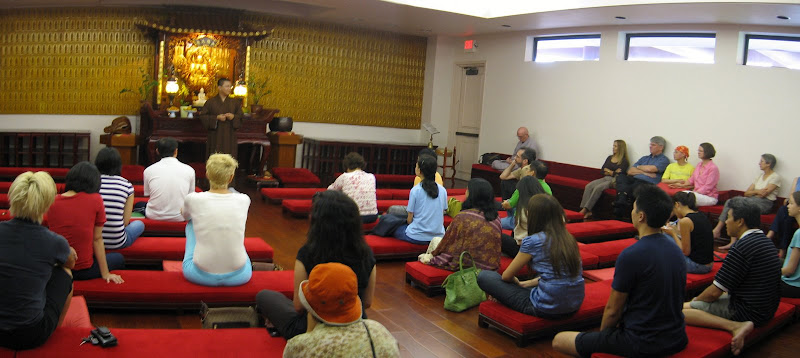
Master giving meditation instruction

Workshop Title: Meditation for a healthier you

Location: University of Houston Wellness center

Sponsor: UH Wellness Center

Time: Wednesday, September 10, from 1:30 – 2:30 pm

Master Jian Dan was invited by the University of Houston Wellness Center to be a speaker at their wellness program and address the topic of meditation for a healthier you. We all strive for a healthier body. However, going to the gym only fulfills half of the equation. Research has indicated that regular meditation helps regulate blood pressure, stabilize emotion, improve concentration and reduce stress, all of which contribute to a healthier life style. In this interactive workshop, Master explained the various benefits of meditation and demonstrated breath-counting method, a proper and safe way of meditation. Participants meditated and asked questions at the end.

Today also marks as a milestone for Master’s dharma work. Even though he has been giving talks at student clubs and classes, this is the first time he accepted an university-level invitation and participated in university-level event.

Two more university-level talks coming up this semester. On October 28 and 30 at 4pm, come to UH Learning Support Service and Master will give two talks about reducing academic stress through meditation. Stay tuned for more updates.

8/15/2008

New Class: Bodhisattva’s Practices (in Chinese)

Boddhisattva is a compassionate being who seeks enlightenment not only for him/herself but also for all sentient beings. Bodhisattvas practice six paramitas (giving, virtue, tolerance, diligence, concentration and insight) to cross the Sea of Suffering, enter Nirvana and attain enlightenment. In particular in Mahayana Buddhism, there are four Boddhisattvas who are widely honored and recognized: Avalokiteśvara (Guan-Yin) of compassion, Manjusri (Wen-Shu) of wisdom, Samantabhadra (Pu-Xian) of great vows, and Kṣitigarbha (Di-Zang) of great practice. This semester, Master Jian Dan will detail the vows and practices of these four celebrated Boddhisattvas and guild us on how to put our understandings into daily life.

Date: Sundays (starting August 24, 10 classes)
Time: 1:00 - 3:00 pm
Location: Jade Buddha Temple conference room
Materials: The Way to Buddhahood and other materials as assigned in class
Class website: Buddhism Discussion Blog

7/06/2008

Connectedness in Life


There was a farmer who grew award-winning corn. Each year he entered his corn in the state fair where it won a blue ribbon. One year a newspaper reporter interviewed him and learned
something interesting about how he grew it.

The reporter discovered that the farmer shared his seed corn with his neighbours. "How can you afford to share your best seed corn with your neighbours when they are entering corn in competition with yours each year?" the reporter asked.

"Why sir," said the farmer, "didn't you know? The wind picks up pollen from the ripening corn and swirls it from field to field. If my neighbours grow inferior corn, cross-pollination will steadily degrade the quality of my corn. If I am to grow good corn, I must help my neighbours grow good corn."

He is very much aware of the connectedness of life. His corn cannot improve unless his neighbour’s corn also improves. So it is in other dimensions. Those who choose to be at peace
must help their neighbours to be at peace. Those who choose to live well must help others to live well, for the value of a life is measured by the lives it touches. And those who choose to be happy must help others to find happiness, for the welfare of each is bound up with the welfare of all.

The lesson for each of us is this: if we are to grow good corn, we must help our neighbors grow good corn. With the same token, if we are to live a fulfilling life, we must help people around us to live a fulfilling life. If we want "pure land" - however your personal definition might be, we must elevate everyone around us to that level so, together, we can cultivate an environment of pure land.

All living beings are inter-connected. We celebrate the connectedness in life by being open minded and kind to all.

This speech was delivered at the Grand Hall of Jade Buddha Temple, aided by a PowerPoint presentation.

6/29/2008

Conclusion of Summer Classes


Five weeks went by as quickly as a summer afternoon thunderstorm. Friday night’s Dharma Assembly on Universal Door Chapter and Sunday afternoon’s lectures on The Eight Great Awakenings Sutra l (both conducted in Chinese) came to a conclusion today.

Through weekly chanting, prostration, meditation and short dharma talks, participants gained insight into Universal Door Chapter and the spiritual powers of Guanshiying Bodhisattva. Total of 52 people attended this class, of which 13 achieved perfect attendance and additional 11 attended four times, totaling 25 people to receive a graduation certificate today. This dharma assembly was so well received that at the last class participants eagerly requested that Master should continue the assembly.

Similarly, the lecture class on The Eight Great Awakenings Sutra was also a success. Detailed class notes can be found here. Many participants asked the Master to slow down the class or extend the class to more weeks so students can better digest the content. This was the first time that students were required to memorize the sutra. Each week, participants would memorize assigned passages and the Master would randomly select a couple students for examination. To the Master’s delight, participants were all diligent and memorized the sutra well. Forty two (42) participants attended this class, including 12 perfect attendees and 5 who attended four times. These 17 people received a certificate of accomplishment today as well. It is worth noting that both classes drew different people even though about ten people participated in both classes.

As part of the celebration, we watched a movie - Running on Karma (Hong Kong, 2003). Dinner was offered by the Master afterward. Stay tuned for new class information in the fall.

6/01/2008

English Dharma Group speech - Freedom in Buddhism


Master Jian Dan was invited to give a talk at the English Dharma Group, Jade Buddha Temple, exploring what freedom means in Buddhism.

Master introduced the three levels of freedom – personal, relationship, and environment. In order to achieve personal freedom, we need to be awakened from our wondering thoughts and attachments. When our mind is like a mirror that reflects indiscriminately of the truth presenting, we have eradicated our afflictions and attachments and therefore achieving personal freedom. For cultivating better relationship, we need to be flexible, as illustrated by the story of the little river (please refer to this talk about the story). When your mind is awaken, you know when and how to change your current form – attitude and intention – to better fit the present situation. Lastly, Master referred to the concept of Pure Land where people are in harmony with everyone else, with animals, and with the environment. The concept of Pure Land is that of harmony, in the present moment. In order to achieve the ultimate level of freedom, we have to start from ourselves, therefore the practice of meditation.

Meditation helps us see our mind more clearly. We can observe and detect its change; we are more aware of its current state. Through continued practice, we control our emotion instead of letting our emotion controls us. Some Q&A followed.

5/27/2008

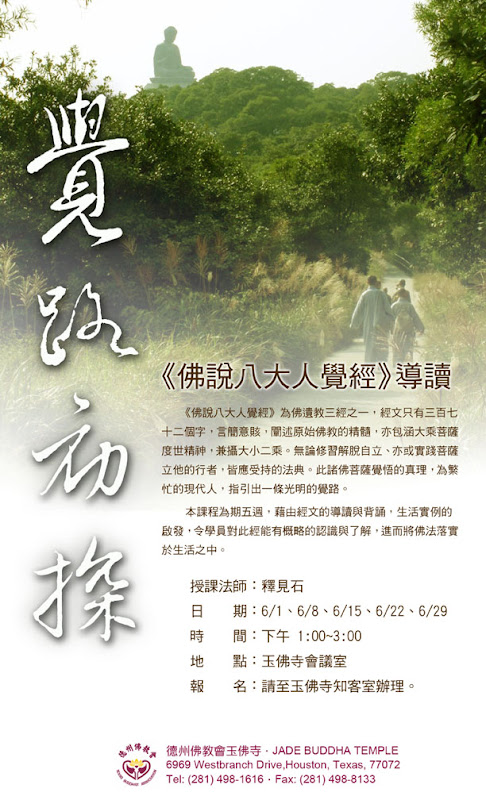
New Class - The Eight Great Awakenings Sutra (in Chinese)

As one of the earlier translation of Chinese sutras, the Eight Great Awakenings Sutra has only 372 words and is one of the shortest and most concise Buddhist sutras. This sutra has been dedicated to lay followers before Buddha’s attainment of Nirvana. Many regard this Sutra to encompass Buddha’s fundamental teachings preached during his lifetime. It has similar characters as the Sutra of Forty-two Sections and the Testament Sutra, which are particularly sacred to monastic disciples. This sutra is entirely in accord with both the Mahayana and Theravada traditions where the texts address both the way to self realization as well as the path of Bodhisattva.

If Buddhist disciples recite this Sutra on the Eight Awakenings, and constantly ponder its meaning, they will certainly eradicate boundless offenses, advance towards Bodhihood, and will quickly realize Proper Enlightenment. They will always be free of birth and death, and will abide in eternal bliss – The Eight Great Awakenings Sutra

The above excerpt is the conclusion of the Sutra. It emphasizes the importance of putting the eight awakenings into practice in order to attain the benefit of Enlightenment. Only reciting the Sutra is just like a parrot that imitates human speaking, without knowing the real meaning. In this new five-week class, through recitation, discussion, and dharma talk given by Master Jian Dan, participants will gain deep understanding of the eight awakenings practiced by all Buddhas, Bodhisattvas, and Buddhist followers.

Date: Sundays (June 1 – June 29)

Time: 1:00 – 3:00pm

Location: Meeting room @ Jade Buddha Temple

Registration: Contact temple office

5/26/2008

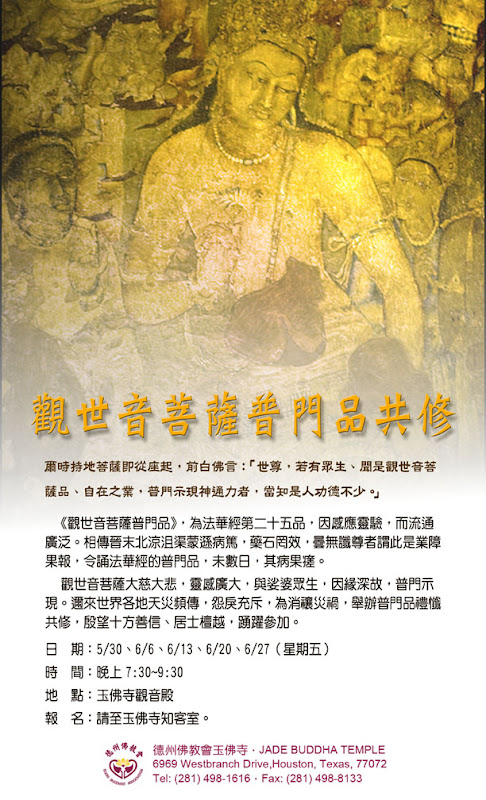
Dharma Assembly: Universal Door Chapter (in Chinese)

At that time the Bodhisattva Guardian of the Earth rose from his seat and said to the Buddha, "World Honored One, if there are those who hear this chapter of Guanshiyin Bodhisattva, who learn about the self-mastery of his deeds and the power of his spiritual penetrations as shown in this Universal Door, you should know that the merit and virtue of such people will not be small."

The above excerpt came from chapter 24 of the Lotus Sutra. Containing 28 chapters in total, Lotus Sutra is one of the earlier Mahayana Buddhist texts. Widely regarded as a Buddhism classic of great beauty and power, Lotus Sutra also represents one of the most important and popular texts in the Mahayana tradition, a form of Buddhism predominant in East Asia. Chapter 24, titled Universal Door, focuses on the spiritual powers and miraculous functions of the inconceivable state of Guanshiying Bodhisattva, the Bodhisattva who Contemplates the Sounds of the World. It is believed that if we recite this chapter in great concentration and sincerity, we can experience this inconceivable and miraculous power ourselves.

Master Jian Dan will lead a five-week dharma assembly, reciting the Universal Door Chapter. In addition to chanting and prostration, Master will give brief dharma talks on this chapter.

Date: Fridays (May 30 – June 27)

Time: 7:30 – 9:30 pm

Place: Guan Yin Hall, Jade Buddha Temple

Registration: Contact temple office

5/24/2008

Meditation for Children: Skillful Kong Fu for the Mind

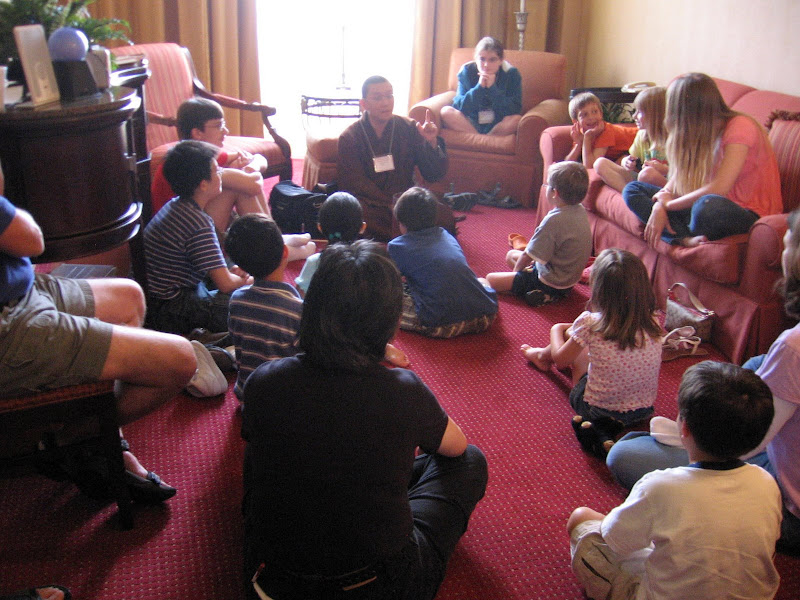
A room full of children paying attention to Master's animated talk


As part of the invitation from Gulf Coast Mensa, Master also conducted a meditation session for children this afternoon. In this one-hour interactive talk, Master Jian Dan interwoven stories with live demonstrations to show how children can practice and enjoy meditation. Many children are involved in some forms of physical exercise to develop a stronger body. To be skillful at any physical exercise, one must practice on a regular basis. Soon, many of the techniques become second nature and children will spontaneously use them when necessary. The same principle applies to meditation, which could be considered a skillful Kong Fu for the mind. Through meditation practice, we learn to still our mind, examine our inner emotions, observe how emotions arise and fall away, and ultimately gain the skill to moderate our moods accordingly. Over time, we will become skillful in “fighting” negative emotions even before they arise. Emotionally balanced children benefit from a stable, tranquil mind and can have a more fulfilling and happier life. Several smaller segments of guided meditations were conducted. With this group of children aged from four and above, Master spent an interactive and entertaining hour with them. Afterward, many asked to take a picture with the Master. Master also gave them bead bracelets as a gift of blessing.

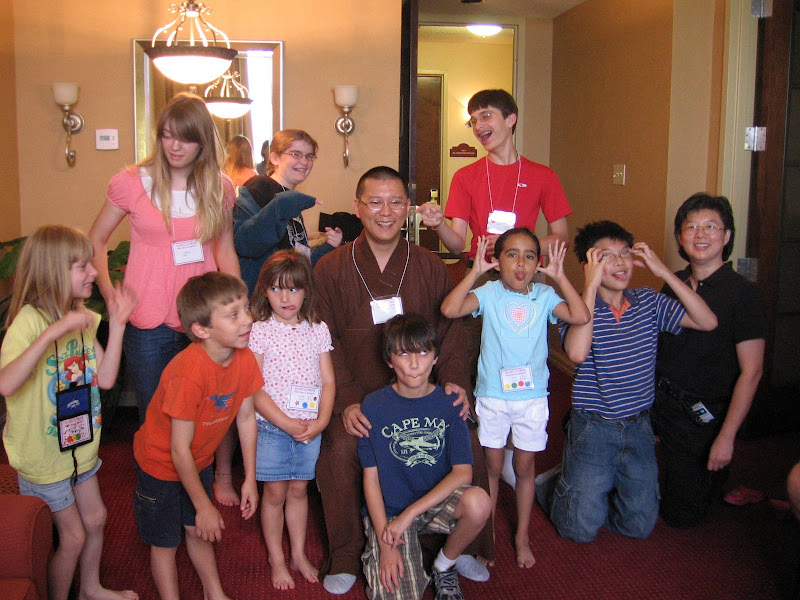
Children making funny faces for the camera


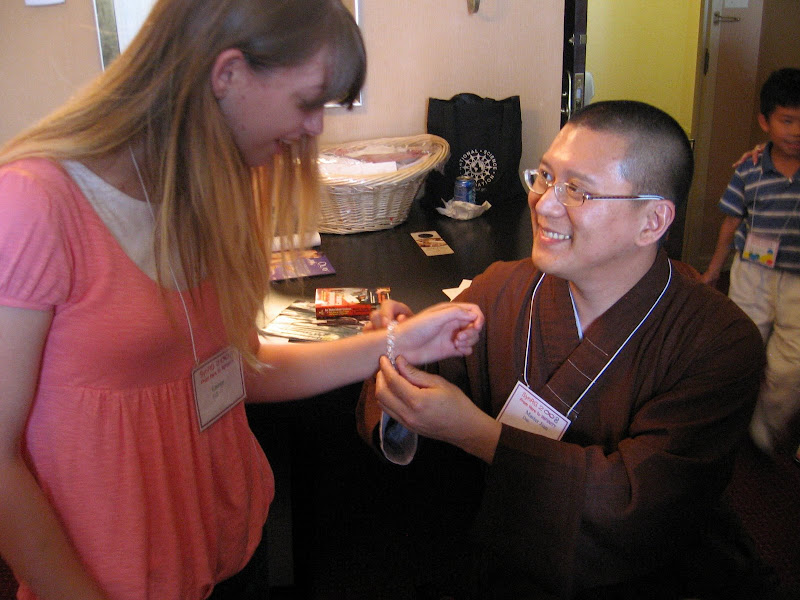
Master giving out bead bracelets as blessing gift


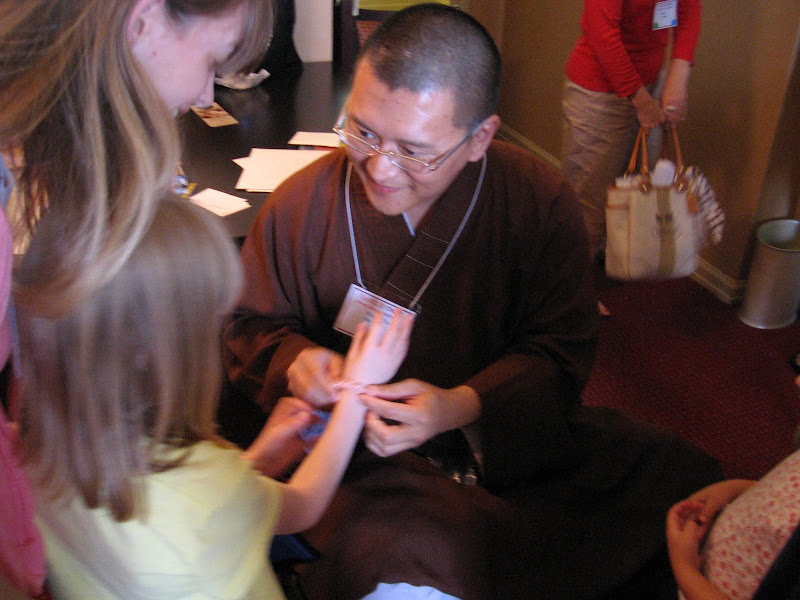
Children were eager to receive the special gift from the Master


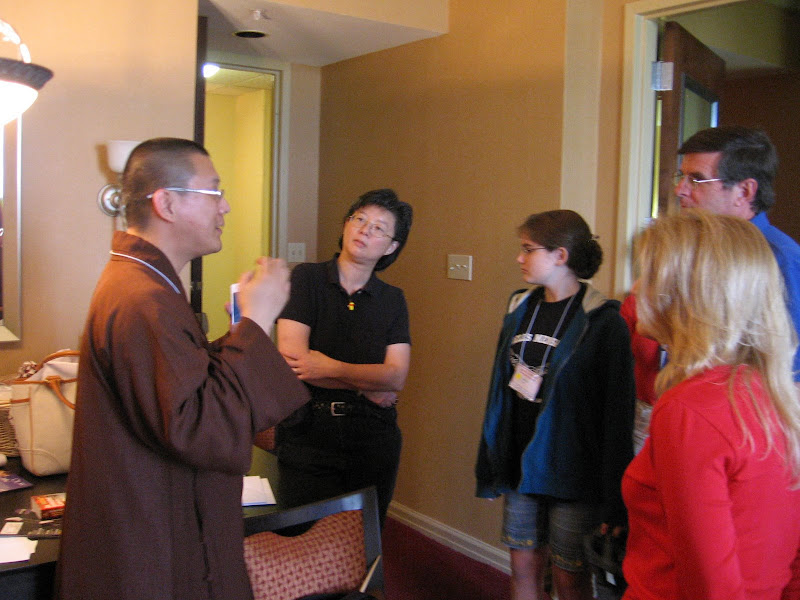
Parents stayed afterward and asked many questions about meditation