5/24/2008

Nothingness Explored


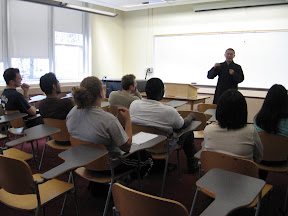
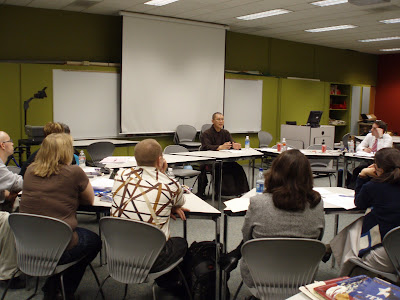
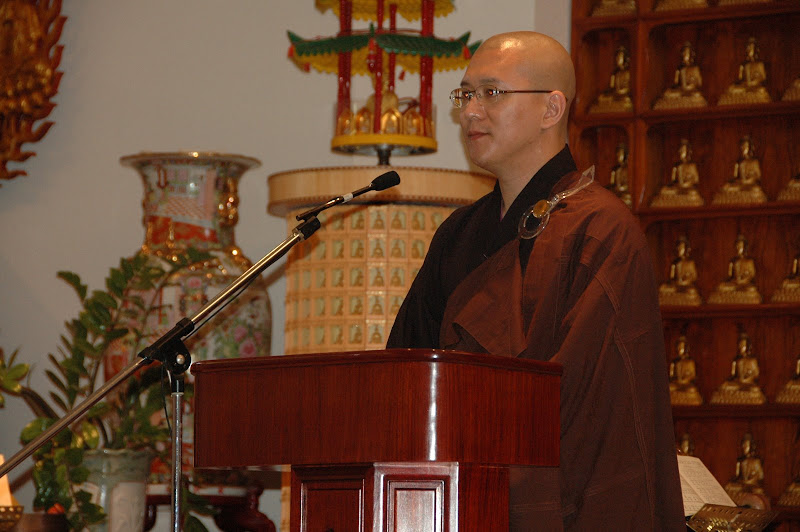
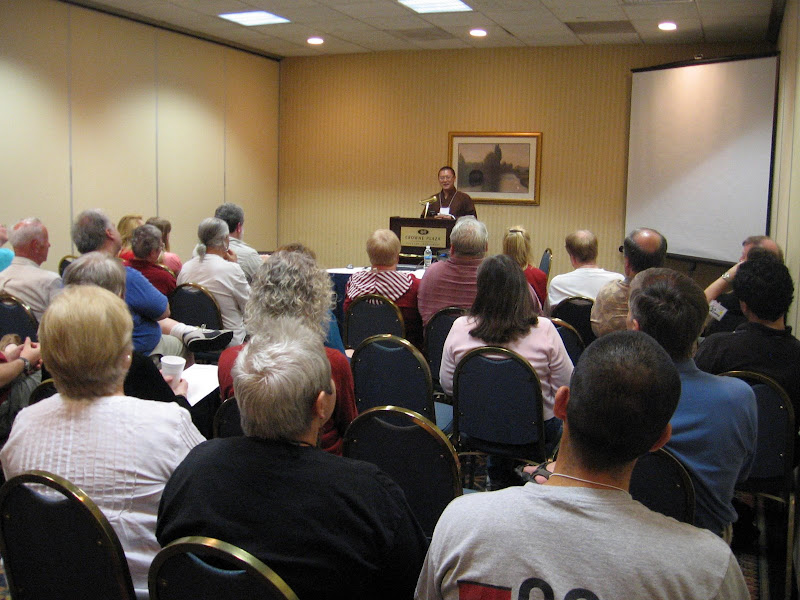
Mensa is an international organization whose only membership requirement is a score in the top two percent of the general population on a standardized intelligence test. Such an interesting group has a Gulf Coast chapter in Houston. Each year, the Gulf Coast Mensa holds a memorial weekend convention where “forward-thinking Mensans” get together to enjoy a weekend “filled with interesting speakers, games, dancing, good conversation, and fun.” Through contacts, they invited Master Jian Dan to give two talks at their annual convention, one aiming at adults about Buddhism and meditation, another aiming at children about meditation.

What can Master Jian Dan offer to this group of highly intelligent people who probably know more about many things than Master Jian Dan? “But I do know at least one thing you probably don’t. That is, today, I will teach you about nothingness.” The audience seemed intrigued by this statement.

“Many of you think it is easy to be a monk – you just do nothing all day long.” Master Jian Dan challenged the audience further, “you all are working very hard, running around between, work, family, children. Why don’t you try to do nothing, think nothing for a moment and see if it is easy.” Master asked the group to sit on the chair, close their eyes, and do nothing for three minutes.

Three minutes probably felt like an eternity. Audience shared that they cannot concentrate, kept thinking about something, kept hearing speaker from next room, etc. From here, Master directed the group into the essence of Buddhism and meditation.

Master introduced the mirror analogy as an example of how true mind should function. A mirror reflects all images in front of it without discrimination. If the surface of the mirror has dusts, a mirror will lose its function and unable to reflect things as they truly are. Our mind originally is like a mirror - clear, spontaneous and non-discriminating. This is a God giving quality that in Buddhism we called Buddha nature. When Sakyamuni Buddha reached enlightenment, he discovered this amazing phenomenon that “all sentient beings possess the same Buddha nature. It is only due to our delusions (wondering thoughts) and attachments, we are unable to attain Buddhahood (enlightment).” So the dusts on the mirrors are our wondering thoughts, past experiences, and attachments.

Master then gave an example of a dance recital. He was invited to attend a recital by a disciple. There were about 30 girls on the stage and the disciple was taking pictures the whole time. Afterward, Master saw the pictures in the camera but there was only one girl – the daughter of the disciple – also his attachment. Because Master was not attached to any single child, “I was able to see everything, therefore seeing the whole picture as it really was.” This example shows that when we have attachments, it is like the mirror with dusts, we can only see partially. However, when we are able to detach ourselves, therefore the clear mirror, we are able to observe the entire situation. Meditation helps us detect our attachments and train our mind to eradicate them.
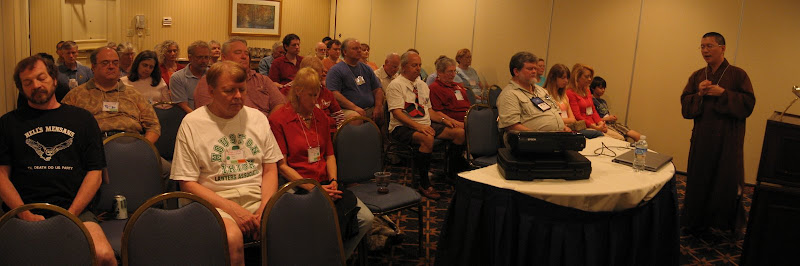

Breath-counting method was introduced and a five-minute guided meditation was conducted. With the technique, audience found it easier to concentrate, even thought it was still difficult. Master reminded the group that training our mind to be strong enough to “shut down the background noise” requires routine practice. We are accustomed to allowing our thoughts wonder without knowing it. Thoughts are like seeds in the field. Without proper conditions, such as water and sun, the seeds will not be able to grow. When we follow our wondering thoughts, we give our thoughts energy. It is like the seeds that have received water and sun and now have grown into trees. If we continue to “give our wondering thoughts energy,” Master explained, “we will eventually imagine a garden with not only trees, but flowers, butterflies. We create the entire scenery and live in it. Eventually we live in this beautiful garden created in our mind.” This garden is our deluded mind, detached from reality and true situation. Meditation is the practice to have a strong mind so it does not wonder and got lost. Once we develop this ability to understand our thoughts better, we will be able to see things more clearly.


A longer meditation was conducted and audiences were eager to ask questions at the end. Master concluded the talk by referring back to the notion of “nothingness.” Master reminded us that when we reach that tranquility of mind where we are not attached to anything, the state of nothingness, we actually achieve the state of “all encompassing” as well. Nothingness needs to exist in order for somethingness to take place. As a matter of fact, eeverything arises from nothingness. When we open ourselves up for infinite potential, we work with nothingness to achieve somethingness. Ultimately, when we keep our mind in the state of perfect equanimity, our inherent wisdom will naturally arise.

5/10/2008

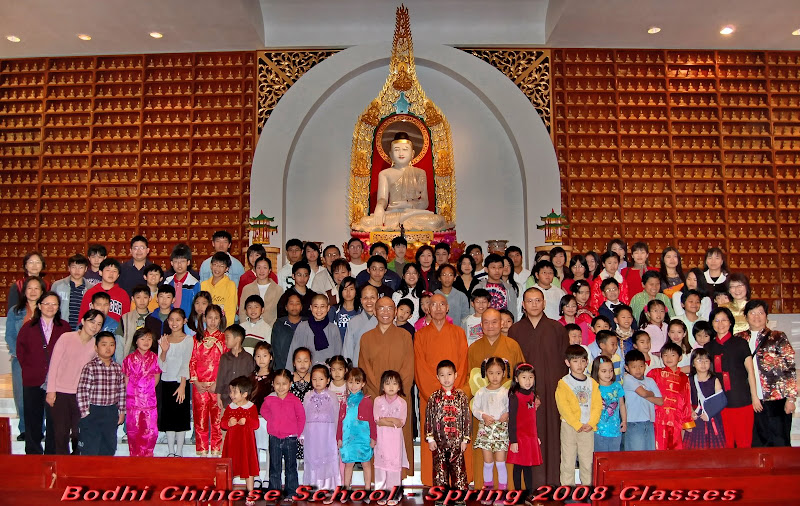
Bodhi Chinese School Commencement

Master was invited to attend Bodhi Chinese School’s commencement this morning. Master has always been interested in involving children in his dharma work. He believes that one of the best gifts a parent can give to his or her children is to let the children get in touch with meditation early on. For him, mediation can help children develop discipline and learn how to balance their emotions. An emotionally well-balanced child can learn better, has more friends, and lives a happier life. Master has a successful track record in leading children’s mediation camps and classes. For more information about his dharma work with children, please visit his Awesome Youth Group blog.

4/28/2008

Jade Buddha Temple Member gathering

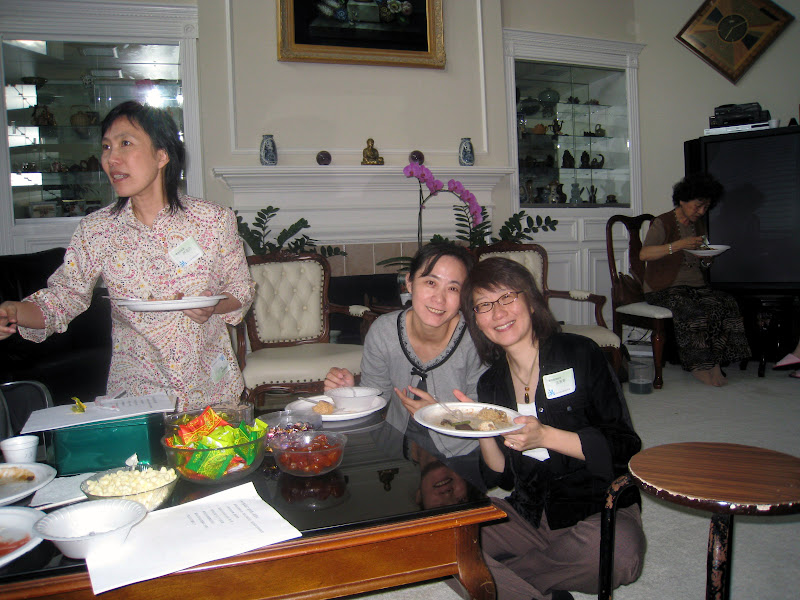
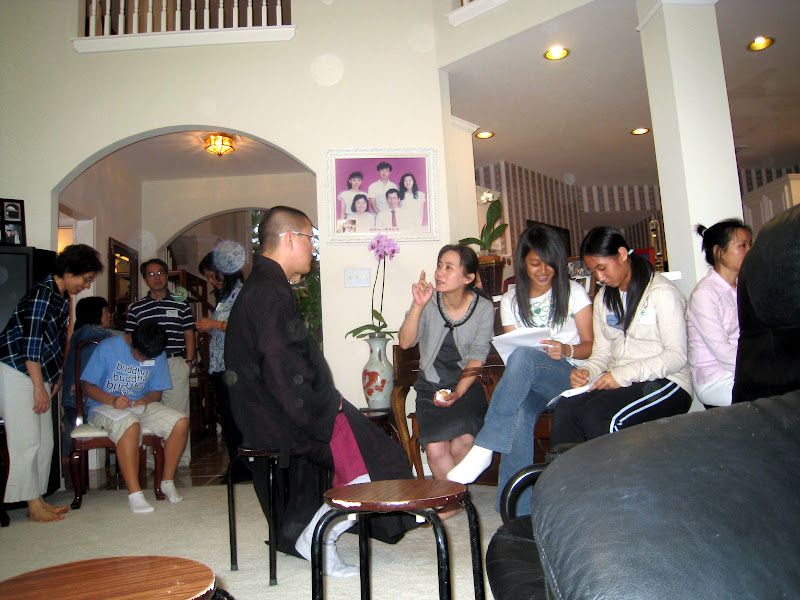
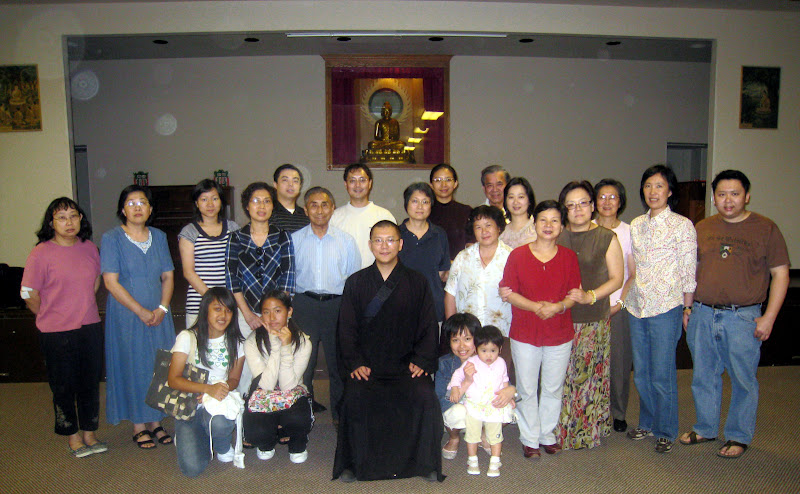
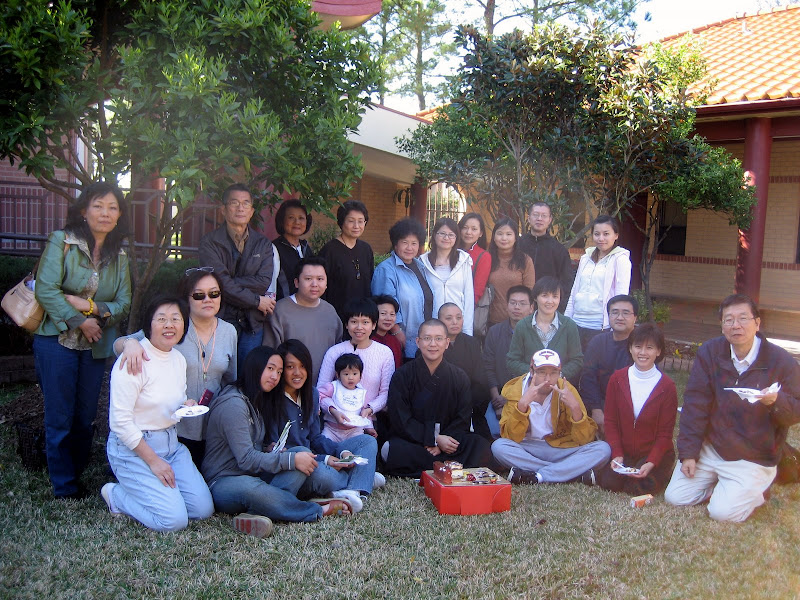
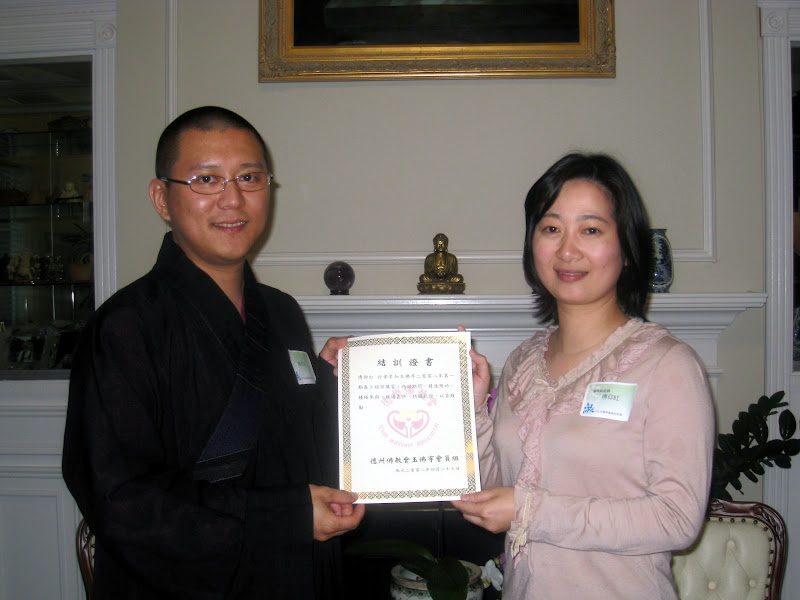
Master Jian Dan held a member gathering yesterday evening. The main purpose was threefold. First, Master used this opportunity to award certificate to students who completed the volunteer training class offered several weeks ago. About 35 people received their certificate of completion. In addition, Master used this opportunity to communicate his vision and future plans for Membership Group at Jade Buddha Temple. Lastly, this was a chance for members to get to know each other and to build team spirit.

In conjunction with the award ceremony, members were asked to give feedback about the volunteer training as well as the hands-on practices of either the Guan-Yin Ceremony or the Buddha Relics Resting Ceremony. Many feedbacks were received and they will be taken into consideration for future planning.

4/27/2008

Graduation Ceremony for Intermediate Dharma Class @ Jade Buddha Temple


The ten-week intermediate dharma discussion class has come to its fruition. Nine students attended all class and received a special perfect-attendance gift from the Master. It is worth noting that eleven students had missed only one class. This impressive record speaks not only to the dedication of the students but also how well received the class has been.

This semester, Master Jian Dan went through first half of Chapter four of “The way to Buddhahood” (by Venerable Yin-Shun) in great details. We spent several weeks studying and contemplating the concepts of Four Noble Truth and Twelve Casual Chains. Master even added additional materials to help us understand each concept as well as how they are related to each other.

Chapter four centers on the concept of the “three vehicles.” Three vehicles are three ways of practice that are considered for different capacities of sentient beings. These are the vehicles of Saravaka, Paratyekabuddha and Bodhisattva. Saravakas are Buddhist practitioners who understand the Four Noble Truth in entering Nirvana while Paratyekabuddhas reach enlightenment by contemplation on dependent arising or Twelve Casual Chains. Even though these concepts sound theoretical, Master was able to position them in everyday life, which allowed us to be able to readily relate to these concepts in a more concrete way.

Our last assignment of the semester was to write reflections of what we have learned. Below are excerpts from students’ writings

Many people think they have Buddha in their mind, so they don’t need to listen to dharma talk. Others think they are not at the level to understand dharma talk. What I want is to start from the beginning, change my old habits. Many people have very strong self ego..I hope to learn how to control my mind, eradicate myself from afflictions, cultivate awareness and better myself.
Recently I had a dream that seemed very real… In the dream there was beautiful scenery, sounds, colors, etc… then I realized I was in a dream so I woke up. Upon waking up, this poem appeared:
While sleeping, six directions of reincarnation from hells to heavenly beings seemed vivid
Now I am awake, a billion desire worlds that are vast and interwoven result in only emptiness

I deeply realized that our awareness is always present. However, we have to cultivate it diligently.
I learned the concept of “change our mind” and how to apply it in my life. One time I sent an email to an employee asking for some information. I waited for a while but did not receive the data. I typed up a reminder email with some harsh words. But then I changed my mind. I deleted that email and walked over to him. I said, “I am sorry. I think my email did not explain clearly. I really need this information in a hurry. Is it possible that you can get it to me soon?” I saw that his face turned red. Five minutes later I received that I needed. He never delays anything I wanted from that point on.
After this class, I realized all afflictions arise from not understanding the truth, from the wrong views. Listening to Master explaining some of the concepts in great details helped me recognize that affliction has been my good friend all along, twenty four hours a day..
The more I learn about Buddhism, the more I appreciate its extensiveness and depth
Before this class, I thought a Buddhist’ practice meant to perform all goods, avoid all evils. After this class, I grasp the importance of supporting the Three Jewels. At work, if I encounter unfairness, I now can treat it with calmness. The emotions of sadness, anger or even rage are all due to our greed… Buddhism guides me in applying what I learn into my daily life, in order to continuously improve myself.
I learned how to look up Buddhism teams using online dictionary. Now if I encounter any terminology, I simply look it up. By looking up terms through a dictionary, it increases my study efficiency and brings more fun into the study.
My biggest take away from this class is that I learned not to keep things inside me. Sometimes I have disagreement with coworkers and I got angry. Gradually I learned to let anger go because I now know being angry will not help resolve the situation.
I did not believe in cause and effect before…Now I understand we should put our efforts on the “cause”. If we believe in cause and effect, we will have a better life and can face reality easier… I try to plant good “causes” in this life so that I could enjoy good results in the future. “Live the moment” is another concept I came to appreciate. We cannot change what had happened and we cannot control what will happen. We should appreciate what we have at this moment. Life is fuller and happier this way. Even if we run into problems, we know how to face it, accept it, then let go of it.
I thought Buddhism is about going to the temple, burning incents and chanting sutra. Now I know impermanence is a universal law and we need to constantly improve ourselves.


After the graduation ceremony, we watched the movie Fluke. And had a short discussion about reincarnation, preconceived views, and the meaning of live the moment.

All students eagerly anticipate the start of next semester where we can continue to learn more about the way to Buddhahood.

4/16/2008

Introduction to Buddhism & Meditation (University of Houston)

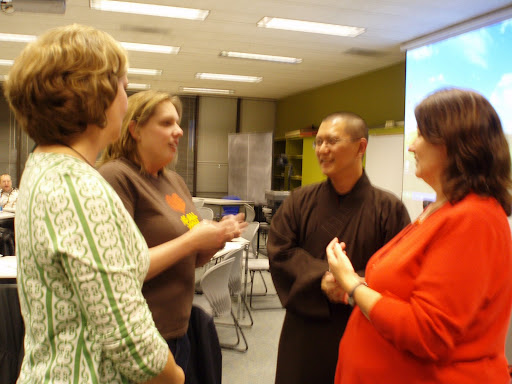
Master Jian Dan delivered an interactive talk at University of Houston to a group of undergraduate students about Buddhism and meditation. Master explained that Buddhism is more of a way of living than a religion and that Buddha is a person who has reached a pure state of mind, a state that we all can achieve. Buddhism believes that we all have this original, pure Buddha nature. Unfortunately, due to attachments, this original, pure mind is deluded with wondering thoughts. Meditation is a tool, a practice, a skillful means, to help us settle down our attachments and reach the mind of tranquility.

So, how can meditation help?

Water Demonstration

Master Jian Dan brought out a big glass tube of water. “This is your original, pure mind. It is clear and calm.” Then he started pouring some red beads into it. “This is your anger when you argue with your girlfriend or boyfriend.” As the beads traveled down the glass tube, Master used a stick to stir them up. “But you cannot let go of your anger. The more you think about it, the angrier you become.” Master poured another bag of purple beads into the tube. “This is your sadness when you received a bad grade from school.” Another bag of blue beads were poured into the water. “This is your children when they do not listen to you.” Master continued to stir the water so all the beads were in a whirlpool, unsettled, restless. “Different color beads represent different emotions. When you give them energy by continue to think about them, they cloud your mind and you cannot see clearly.” Master Jian Dan continued, “So how can you calm your mind? You let thoughts settle down. You let the beads sink to the bottom by not stirring them. Learn to control your mind and ignore all wondering thoughts.”

This water example really helped students make the connection between meditation and clearing our mind. One student wrote on her survey, “The water demonstration was very insightful. It made it much easier to visualize how to clear your mind and let your thoughts go.” Another student echoed, “The explanation of how the mind is like clear water and then you add in the beads that represent thoughts and emotions, all stirred up. That made me think about the clear mind in a different way.”

Conversations between the Master and the students

Two guided meditations were offered where Master taught students the basic breath-counting method. After the meditation, students were eager to ask questions. Below is a snapshot of some of the questions and answers from today’s talk.

Student: Can a Buddhist monk get married?

Master: No.

Student: How old are you?

Master: It is a secret.

Student: How many colors are there in a monk’s robe?

Master: Black, brown and grey as they were considered “dirty” or “bad” colors in ancient time. Black becomes a fashion now but people did not like it before. Wearing undesirable colors is also a training to detach from material desires.

Student: Are you paid to be a monk?

Master: No, but according to the Chinese tradition, we accept offerings from laid disciples. It is also because of this tradition, when I get sick, I keep my mouth shut. Otherwise I will receive a lot of medicines from people.

Student: Why breath-counting method?

Master: There are different techniques but breath-counting is the easiest and safest to practice without a teacher. In addition, we usually are not attached to a number so later we can even easily let go of the numbers.

Student: It is very hard to ignore thoughts during meditation.

Master: That is why we call meditation a practice. Learn to give your mind the strength to ignore thoughts. We simply do not follow our thoughts and make a story out of it. Once we ignore a thought, it loses it energy and it will eventually disappear.

Student: Why is it a good thing to not to attach to things?

Master: When you are attached, you are limiting your world view to only the attachment. When you are free from the attachment, you are open to see the whole picture, therefore the truth. In reality, learning Buddha’s teaching or even counting the breath are also forms of attachment. Eventually we will have to “empty our emptiness.” At that point, we cease reincarnation.

Student: What is reincarnation?

Master: It is the arising (birth), falling away (death), and the recurrence of our thoughts. The same thought keeps coming back and we cannot jump out of this endless loop of suffering. True understanding of reincarnation lies in the awareness of the function of our mind.

Students: What are the differences among different schools of Buddhism?

Master: The basic concepts are the same but each school has adapted to different cultures. In 50 years, American will have its own unique variation of Buddhism.

Student: Are there hierarchy in monks?

Master: Not in Buddhism but since we respect our teachers, we might call them the Grand Master.

Student: Do you dress this way 24 by 7?

Master: When I was in Taiwan, yes. In America, it is a little more flexible so I will change to plain attire when exercising. The way we dress also distinguishes us from others. However, in 10 years, maybe this will change too.

Student: If I just don’t like certain vegetables, am I supposed to like them according to Buddhism?

Master: Like or dislike are still from attached standards. They are attachments. One analogy we often use is to say that our mind should be like a mirror. A mirror reflects what is in front of it without picking and choosing, liking or disliking. A mirror clearly knows the object in front of it and reflects the truth.

Student: If I like to follow the Buddha’s path, what do you suggest?

Master: Find a temple or center close to you and find a good teacher.

Student: good or bad aren’t them the same if we follow Buddhism’s concept where there is no duality?

Master: Like a baby learning how to walk. The baby has to first rely on the walker or the wall. Likewise, we will have to fist rely on the “good” to help get rid of the “bad.” You will not be able to learn anything if the teacher is no good.

Student: I have road rage. How can I get rid of it?

Master: Find an excuse for the other person. He or she might have an emergency. Secondly, I want to treat myself nicely. I don’t want to treat myself with anger.

Student: Is it difficult to be a monk in the west?

Master: It is difficult to be a monk in the east since we have to carry a lot of traditional burdens. It is more flexible here with more possibilities.

Overall reflections

Overall, students seemed to enjoy the talk and the meditation training. They find the talk “informative” “enjoyable” “educational” “very enlightening and very insightful. I plan on implemented some of the Master’s teachings into some of my own teachings” “I really liked his examples” “Master was very interesting. He really tried his best to explain and answer all questions.”

While some felt the talk “gave me a new outlook about Buddhism,” and “I will seek more information … so I can further myself,” many unanswered questions still lingered in students’ mind. For example, one student felt s/he liked to know “how American society reacts to Buddhism.” Yet another wanted to know “the difficulties monks encounter in the US compared to their country.” One student indicated s/he liked to know more about “how Buddhists live and do everything and how to teach children/others about Buddhism” This question was reiterated by another student, who wrote “I would have liked to know how a person implements this in their daily life.”

Master enjoyed the talk as much as the students did.

4/06/2008

Buddha's Relics Resting Ceremony


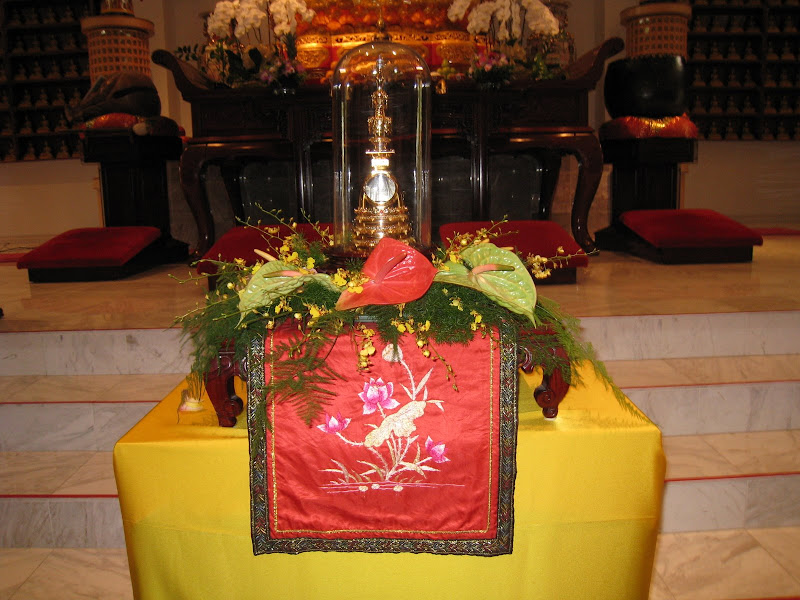
Master Jian Dan coordinated a two-day Buddha Relics resting ceremony at Jade Buddha Temple (public viewing) on Saturday (4/5) and at American Bodhi Center (permanent resting) on Sunday (4/6).

When the Buddha lived in India in approximately 2,500 years ago, the people of that time had the opportunity to actually see and hear him, to be blessed by him in his human form. When Buddha left the earth by passing into nirvana (the enlightened state) during the body's death, he compassionately left relics so that today we still have the opportunity to receive the blessings
of the Buddha, directly.

These genuine relics are offered by Venerable Hung I, the Abbot of Jade Buddha Temple, to permanently rest at American Bodhi Center. In 1971 Venerable Hung I was visiting a temple in Taiwan when he met a traveling monk from India. Impressed by Venerable Hung I's big vow to spread Buddhism in the west, the traveling monk gave Venerable Hung I some of his share of
genuine Buddha relics as a gift. Years later, Venerable Hung I brought these relics, together with his big vow, and arrived in Houston. Thirty years later, we are celebrating the permanent resting of these precious relics in Houston. This event symbolizes the spreading of Buddhism to the west, to Houston, and also the resting of enduring Buddhism teaching in American.

Relics are said to carry positive energy. Interestingly, they are themselves living entities; they can grow bigger, split into more, shrink in size or even disappear. Viewing holy relics inspires us to develop our own Bodhi hearts and minds, to develop loving-kindness and compassion and to understand Buddha’s precious teachings.

In conjunction with coordinating this two-day event, Master Jian Dan conducted a 3-hour volunteer training a week prior. The training aimed to equip all volunteers with the knowledge of how a ceremony like this is carried out, how details are coordinated, and the proper manner and rules in greeting the relics and the guests.

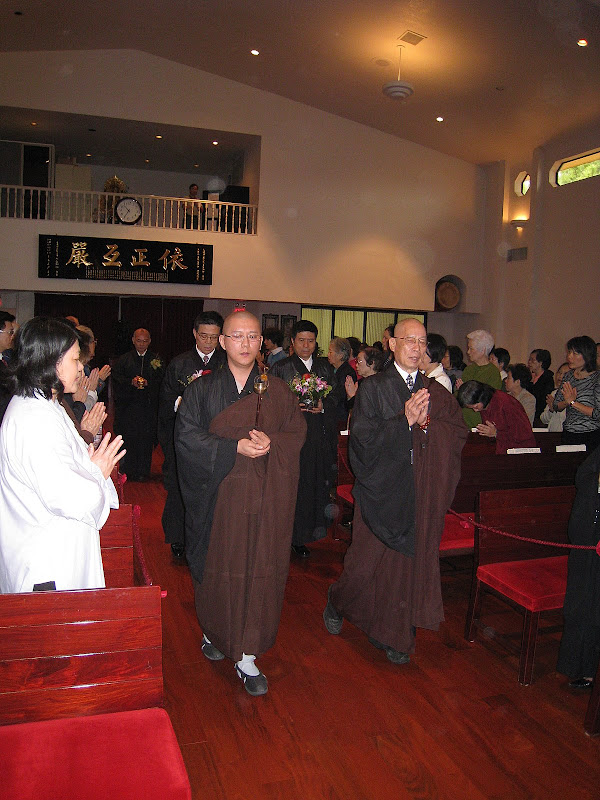
It was a successful event. Can you find some “dharma wheels” in the pictures?

3/10/2008

American Buddhism: Challenges and Possibilities


“Very awesome. Honestly, I was not expecting somebody so young and modern. Again, very awesome.” One student shared his/her reflection on Master Jian Dan’s talk today.

Humorous Monk

“I visited Los Angeles last summer. My disciple asked if I like to go to Disney Land. I immediately rejected this idea. I was afraid that if I go, tourists would think I am one of the new cartoon characters, probably from Mulian, and everyone would want to take a picture with me!”

Students laughed and right away Master grabbed their attention and interest. These students are talking an undergraduate class about “Asian Religions in America” at the University of Houston. Today Master was the invited guest speaker. The class instructor invited Master to talk about the practice of Buddhism in America, how it differs from traditional Buddhist practice--challenges, possibilities, and differences between American and Asian students.

Dispelling Misconceptions

Master first pointed out several misconceptions people have about Buddhism: Buddhists live in seclusion, Buddhism is passive and negative, and Buddhist’s precepts are restrictive. Through stories and logical reasoning, Master explained that these concepts are far from the truth. Master also shared some of the challenges he has faced when trying to spread Buddhism in America. For example, his has to change his teaching style to use more illustration, live demos, and hands-on practice. Nevertheless, as a relatively new concept, Buddhism also has found its way into America. With its fluid nature, Buddhism has been successfully adapted to local cultures. We can see today that we have Chinese Buddhism, Japanese Buddhism, Tibetan Buddhism and so forth. Master predicts that there will be a new form of “American Buddhism” that is integrated with American pop culture. While talking about localization, Master made another joke. “If I ever became homeless and needed to beg for food, don’t be surprised to drive by an intersection and see me holding a sign that reads ‘Templeless, Vegetarian only!’”

Questions?

After the talk, students were eager to ask questions. One student wanted to know what was the biggest temptation Master has faced in American that has forced him to break his precepts? Master explained again that he always asked and tried to understand the reasons behind each precept. As long as he still adheres to the core value of the precept, he always adjust accordingly. For example, in Chinese Buddhism, monks should not have body contact with another person. However, he has to make adjustment as in the west, handshaking is considered polite and giving a hug is customary. Another student questioned how far should a religion change in order to survive locally? This student feared that when a religion, such as Buddhism, adopting and changing from culture to culture, will lose its original form. Master concurred. He was also afraid to see Buddhism losing its core values in this process of localization.

Good time always passes too quickly. Many students still had questions to ask. One student wrote on her reflection, “It was interesting – do you know from early on when you are destined to be a monk? Do you always get provided for? What do you think of people who adhere to a religion with a God And Buddhism? Wish we had more time!”

Survey Said...

Here are some things the students said about today’s talk, as collected by anonymous surveys.

1. What was the most interesting thing you learned today? Why?

  • The great sense of humor the monk had and the way he deals with American society. The way he approaches Buddhist practice
  • I just had a different concept about a monk. I thought he would be older and serious, but this monk was young and very funny. Some of misconceptions were cleared
  • The difference b/w Chinese and American young society
  • I had never considered that America would likely develop its own form of Buddhism, but it makes a lot of sense
  • How integrated the monk was in technology. He had an IM account & cellphone
  • That monks have modern ideas about today’s culture – technology – there is no need to isolate yourself
  • That Buddhism is not a religion to the monk but it’s just a way of life. And that monks are very modern. Because learning that made me kind of question the uniqueness and the originality that Buddhism had.


2. What was one new concept you heard today that was difficult to accept/agree? Why?

  • I am not a fan of reincarnation and I have a hard time with it. I don’t really understand it. It doesn’t sit well with me
  • Personal concept of gay marriage. It is not what I am used to growing up with and disagrees with my religious view, but I understand his reasoning
  • The monks don’t follow all 250 precepts – then why are they there? At what point can you decide whether or not they are still relevant?
  • There was nothing that offended me.
  • Cannot eat meat and some vegetables.
  • I find it hard to agree that reincarnation can cause “confusion” in the sex (female & male) and that the definition of it is the character of a person because I think physical aspect of a person is very important too and it kind of confuses me how pervious life can affect “this life” when only the present matters.


3. What was the one thing presented today that you might like to explore further? Why?

  • Meditation and calming the mind. Learning to live my life fully as someone who is comfortable with myself and living in the present.
  • Very interesting analogy with the power and water and a clustered mind. Want to look further into meditation.
  • I would have liked to hear more about meditation methods
  • How Buddhism is developing in America
  • I like the concept of how Buddhism is adaptable, how it is different in each culture.
  • Live for the present. If you have a good cause now then there will be a good future.


4. Overall reflection on today's talk.

  • I enjoyed it. I am very interested in Buddhism and find it interesting and beautiful. I have lived in a Buddhist monastery for a few months and really am interested in practicing it.
  • Very entertaining and informative. Thoroughly enjoyed it.
  • Better than last semester’s talk, very compassionate being very enjoyable to listen to.
  • I enjoyed the talk. The monk helped dispel some of the misconceptions at what Buddhism is. Also that you keeps precepts to keep your mind clear.

3/04/2008

Volunteer training class at Jade Buddha Temple (in Chinese)

Class A: Friday 3/7, 3/14 & 3/21 from 7:00 – 9:00 pm

Class B: Saturday 3/8 & 3/15 from 1:00 – 4:00 pm

Hands-on sessions: Saturday 3/22 1:00 – 3:00 pm & Sunday 3/23 10:00 am12:00

Total training hours: 10

During the month of March, Master Jian Dan will offer a series of training especially for volunteers. This highly anticipated course will provide much-needed trainings for volunteers so they can be more effective helpers around the temple. The course will cover topics such an overview of Texas Buddhist Association (history, organization, resident monks and nuns, etc), an overview of major Buddhist ceremonies (the origin, the meanings, the proper procedures, etc), the Buddhist way of interacting with each other and with the Masters in, out and around a Buddhist temple, and much more. Keeping it at a practical level, this course will also include four hours of hands-on sessions where participants will role play how to greet guests, how to provide a tour, how to answer questions, how to guide attendees during a big ceremony, and so on.

To encourage participation, Master will have one course on Friday nights and another one on Saturday afternoons. You can choose which time is more convenient to you. Each class will have a limited enrollment of 20 to ensure class quality.

There is already a discussion that Master will develop an English version of this training in the near future for our ever-growing America populations.

2/27/2008

Nontraditional way of viewing the world: An American's feedback

More than a week after Master’s talk at University of Houston, an interesting email showed up in my inbox today. While this person preferred to remain anonymous, she did approach me immediately after the talk and expressed her gratitude toward an interesting talk by the Master. She was very impressed by the way Master addressed freedom and awakening, especially how he was able to give a talk so closely related to readings they have been reading this semester. In the email, she shared her reflection after attending Master’s talk. Here is her reflection:

Research or practice. Freedom or discipline. Individual or community. There appears to be a fundamental disconnect in our lives, a duality if you will, between what we perceive within ourselves and what is observed from without. These dualities often create “either/or” categories which determine unequal distribution of authority and result in depersonalization at the most basic level. Dualities also legitimize certain ideologies and exclude others, by representing “Norms” and casting nonconformists as “Others”.

Buddhism seeks to address dualities by offering what to my Western eyes is a very nontraditional way of viewing the world. Instead of waiting for guidance from without, be it a Bible or a God or a sermon, we are urged to set our moral compasses from within. This, in turn, compels us to scrutinize our own prejudices and belief systems. The notion of taking care of ourselves and examining our own lives before we can begin to examine another’s makes sense to me and speaks to our discussion of Maxine Greene and her concept of wide-awakeness.

Another concept of Buddhism that is difficult to understand from a Western perspective is realizing the impermanence of the things we want to hold close to us. In much the same way Ayn Rand in her Objectivist philosophy urges us to achieve true freedom by not living for another and never expecting another to live for us. Buddhism, to me, addresses much of this idea of freedom in letting go.

How many times have we, as Social Educators, searched for a stepping stone to begin our explorations of something greater within ourselves or within our world? When Maxine Greene asks so candidly in Landscapes of Learning “What shall we teach them? How can we guide them? What hope can we offer them? How can we tell them what to do?” she echoes the doubts of thoughtful educators everywhere while at the same time presenting us a framework of compassion and a route to freedom and wide-awakeness. Social Education through Critical Pedagogy seeks to overcome this “is/ought” duality and the split between theory and actual practice by embracing the idea of paradoxical thinking, which requires we accept the world as more complex and multifaceted.

2/20/2008

The Awakening Mind: Path to true freedom

From Doctoral Semi...

Yesterday, Master Jian Dan gave a talk at a social study seminar at University of Houston. This semester, this group of about 15 doctoral students has been discussing ‘wide-awakeness’, morality and the concept of individual freedom, as based upon the writing of educational philosopher Maxine Greene. Students were interested in knowing how other culture or philosophy approaches these concepts. As a result, Master Jian Dan was invited to present his take from Chinese Buddhism’s point of view.

Master shared a story about a little river. The story goes like this:

A little river travels from far away mountain, passing through villages and forests. One day it arrives at a desert. It thought to itself, “I have overcome many obstacles, so I should be able to pass through the desert!” The little river decides to pass through the desert. However, little river soon realizes that its water is disappearing into the desert. It tries and tries for several times but every time the water disappears. Little river is disappointed and wants to give up, "maybe this is my fate; I will never be able to see the big ocean I have heard so much about!”

At this time, the little river heard this deep voice, ‘If the wind can pass across the desert, river can too.” It is the voice of the desert. However, little river argues angrily, “that is because the wind can fly across the desert but I cannot fly.”

The desert replies,’ That is because you insist on maintaining your current form (water). Therefore you will never be able to pass through the desert. You need to allow the wind to carry you over the desert to the ocean. You need to be willing to give up your current form (water), allowing yourself to be evaporated into the wind.”

Little river has never heard of such a thing. “Give up my current form, disappearing into the wind? No, No” Little river has never heard this concept and has never experienced it before. Asking the river to give up its current form seems like a road to death. “How do I know it will actually work?” little river asks.

The wind encompasses water. It can then fly across the desert. Once reaching the destination, the wind can release the water in the form of rain. Rains become the form of a river and then the river can continue the journey,” the desert replies.

Will I still be the original river?”

Yes and No. Whether you are a visible river or invisible steam, your original quality/true nature has never changed. You insist to be a river but you never really understand what your true nature is.”

So little river brings out all its courage, let go of its current form, and disappears into the wind. Little river allows the wind to carry it into its next destination.

In the story, the little river is willing to give up its current form and therefore adjust to the conditions appropriately. An awakening mind can observe each situation clearly and act accordingly. Buddha means the “awakened one.” As a cultivator, we first need to have the absolute confidence that each one of us possesses the same Buddha nature; it is God giving. Buddha nature is like the mirror: it reflects what is in front of it as is, without distortion, without addition. However, our mirror is covered by dusts so we cannot see reality as is. In other words, we are still asleep. Once we are awake, our Buddha nature will manifest.

Why our Buddha nature is covered by dusts? It is due to our attachments. We attach to all external phenomena: clinging and grasping to what we desire. Attachment to our Buddha nature is like dust to mirror. Once we are awake, once we have our dusts removed, we can see things clearly. We have to free our vexed mind first. Meditation helps us clean our dust, calm our mind, and manifest our Buddha nature.

No one lives in isolation. We cannot really function like a mirror, which only reflects without interacting with objects in front of it. When we start to interact with people and with the environment, we need to have the awakening mind to act accordingly – according to a particular time, a particular space, and in a particular relationship, such as what the little river did in the story.

As Thich Nhat Hanh once said, “Freedom is not given to us by anyone; we have to cultivate it ourselves.” An awakening mind is the path to true freedom.

2/18/2008

Bodhi Chinese School: New Year Carnival


On February 17th, Master Jian Dan was invited to attend Bodhi Chinese School’s annual New Year carnival. Bodhi Chinese School, established 18 years ago, is an affliction of Texas Buddhist Association. The school offers Chinese language and culture classes from pre-k to 12th grade, in addition to English, math, calligraphy, painting, kung fu, and violin classes. Every year, the school holds a carnival the week after Jade Buddha Temple’s Chinese New Year ceremony. This yearly carnival has become a long tradition for fundraising and community gathering. There were performance by each Chinese class, games, raffle drawings, face painting, and much more. Master spent the morning at this event, watching kids’ performed, drawing prices, giving out gifts, and mingling with them. Master enjoyed his time with kids.

2/11/2008

Happy Chinese New Year: Rats bring fortune


Chinese New Year is one of the most celebrated holidays in the Chinese community. On February 10th, Jade Buddha Temple held its annual Chinese New Year ceremony. With over 1,400 people attending, Master Jian Dan had the chance to publicly wish everyone a peaceful year.

According to Chinese zodiac, 2008 is the year of rats. Chinese believe that rats symbolize good wealth and will bring fortune to earth. It turns out this believe originated from Buddhism, a story from Virupaksla. Virupaksla, guardian of the northern direction, is one of the four heavenly kings who are protectors of the dharma. Virupaksla is known for his noble deeds and being the wealthiest among the four heavenly kings. With this great wealth, Virupaksla wished to share them with all beings. Unfortunately, all the precious gems were swallowed by a rat, impersonated by a phoenix. Virupaksla caught the rat and demanded the rat to spill out all the jewels. In the appearance of a warrior god, Virupaksla always has his left hand holding in the lap a rat expelling jewels from the mouth, creating a stream of precious gems spreading on to earth below.

It is from this story that Chinese believe rats bring fortune to earth. During Chinese new year, people always like to wish each other a new year of great fortune and wealth. From Buddhism’s perspective, there are four kinds of wealth.

Of course money is the first kind of wealth. We earn money through rightful means. Then there is wealth of wisdom. We diligently study Buddhism and achieve true understanding, then we obtain the wealth of wisdom. As we know, Buddhism is not just a grand theory but something concrete that can be practiced and applied in daily lives. For example, we can accumulate wealth of good relationship by volunteering at the temple, supporting Buddhism, and be friendly and kind to all beings. If we know how to skillfully utilize our wisdom when volunteering at temple, know how to continuously develop good relationship with dharma brothers and sisters, we will foster helping conditions that will further benefit the development of the temple, the propagation of Buddhism, as well as the spiritual growth of ourselves. This is the fourth and the ultimate wisdom, the wisdom of dharma.

Buddhism is not against money or wealth; buddhism emphasizes how to skillfully utilize the worldly wealth to benefit the dharma wealth. True wealth comes at the realization of dharma wealth.

Many honored guests were present today, including Senator Glenn Hegar and Judge Jim Shoemake with whom Master took a picture.

1/15/2008

Intermediate Dharma class at Jade Buddha Temple

I will be teaching one weekly class about basic concepts of Buddhism at Jade Buddha Temple starting January. The class is offered on Sunday afternoons from 1:00 to 2:30. We use the book “The way to Buddhahood” by Venerable Yin-Shun as the framework to discuss various basic Buddhism concepts. This is a combined class with students from last semester's Friday night and Sunday afternoon classes. We finished chapter 1 to 3 of "The way to Buddhahood" and will continue from chapter 4. About half of the students will repeat chapter 4 one more time. The feedback I received from those students indicated that chapter 4 might be a little less organized and some of the concepts are mixed together. I will need to find different ways to convey those concepts.

12/30/2007

2007 Recap

Activities at the Jade Buddha Temple

  1. 2007/10/21 Speech at Jade Buddha Temple
  2. 2007/10/13 Introduction to Buddhism (quarterly three-hour class)
  3. 2007/09/16 Speech at Jade Buddha Temple English Dharma Group
  4. 2007/06/16 Bodhi Family Night
  5. 2007/06/09 Introduction to Buddhism (quarterly three-hour class)
  6. 2007/05/20 Bathing Buddha ceremony
  7. 2007/03/25_One-day Zen Retreat
  8. 2007/03/24 Bodhi Family Night
  9. 2007/02/17 Bodhi Family Night
  10. 2007/02/11 Introduction to Buddhism (quarterly three-hour class)

Public Talks

  1. 2007/10/31 Speech at University of Houston “When East meets West: from a Buddhist Monk’s perspective
  2. 2007/10/15 Speech at University of Houston “Introduction to Buddhism” course

Regular Dharma Classes

  1. 2007/08/19~11/18 Every Sunday Basic Buddhism discussion class (B)
  2. 2007/08/17~11/16 Every Friday Intermediate Buddhism discussion class (A)
  3. 2007/02/25~06/18 Every Sunday: Basic Buddhism discussion class (A)

Others

  1. Fall 2007, University of Houston, Association of Buddhist Students
  2. 2007/09/17 Daily Cougar News
  3. 2007/07/01~07/04 Youth Summer Camp
  4. 2007/03/12 Interfaith: Mormonism Elder Meeting
  5. 2007/03/01 Mrs. Chen funeral
  6. 2007/02/27 Interfaith: Visiting with the Mormons

12/15/2007

Mission Impossible: Recap UH ABS, Fall 2007

One of the most daunting tasks Master Jian Dan took on in 2007 had to be his involvement with a brand new student organization on University of Houston campus, the Association of Buddhist Students. He took on the role as the dharma teacher, as well as the President, while attending UH for the first semester. Looking back, we have to applaud him for his bravery (and may I say, a little craziness as well. Let’s be honest. It takes a crazy person to commit to such a crazy task!). On a more serious note, we also have to applaud him for a job well done. For twelve weeks, Master Jian Dan delivered dharma talks and provided guidance for students, faculty and staff. Here is a short recap of his accomplishment in Fall 2007.

Warm-Up:
  1. 06/27/2007 Unofficial business meeting: Master Jian Dan was invited to be the dharma teacher for the association.
  2. 08/18/2007 ABS Welcome Party at UH: Master attended the party and met many students interested in Buddhism and meditation.
  3. 08/24/2007 UH Cat's back: Master even joined the organization fairs at UH to help promote the association and attract students.

Meditation Classes:

  1. 08/29/2007 Class 1 – Introduction to meditation: First class. Introduction of breath counting method.
  2. 09/06/2007 Class 2 – Be the master of your mind: Heave and hell is only the state of our mind.
  3. 09/13/2007 Class 3 – Living the present moment: Do not attach to nor follow our wondering thoughts.
  4. 09/19/2007 Class 4 – Cultivating the mind: Emotions are just series of thoughts. Learn to observe them as they arise and fade away.
  5. 09/27/2007 Class 5 – Looking inwards: Our mind is the true creator, not something external.
  6. 10/06/2007 Class 6 – Duality: A discriminating mind is the source of sufferings.
  7. 10/11/2007 Class 7 – Inner beauty: Each one of us possesses Buddha nature and has the same opportunity to reach enlightenment.
  8. 10/18/2007 Class 8 – Dealing with anger: Meditation helps eradicate our negative emotions such as greed, anger, and ignorance by being true to yourself.
  9. 10/26/2007 Class 9 – Cultivating compassion: Compassion is selfishless where self-benefit is fully abandoned for the sake of serving all sentient beings.
  10. 11/01/2007 Class 10 – Understanding death: Life is impermanent yet it never ends.
  11. 11/09/2007 Class 11 – Wants & needs: Needs are our responsibilities while wants are our goals and wishes.
  12. 11/15/2007 Class 12 – a day of appreciation: Pay it forward and together we can change the world.

Extra:

  1. 09/02/2007 Field trip to Bodhi Center: Master brought the students out to Bodhi Center for a day of fun activities.
  2. 09/17/2007 Daily Cougar Interview: Master was interviewed by University of Houston campus newspaper.
  3. 11/2/2007 Merit dedication: Master held a special merit dedication for a member who passed away suddenly.
  4. 12/07/2007 Winter Retreat: Master held a two-day retreat for the association.


Mission accomplished!

11/15/2007

UH Meditation Class 12 – A Day of Appreciation


This is our last class; the semester went by very fast. I like to take this opportunity to thank many people.

I first like to thank Josten and Grace who initiated the idea of establishing this association. After the initial idea, we found two disciples’ kids as the inaugural President and Vice President. They attended the required orientation in creating a campus student organization and registered Association of Buddhist Students. We thank them for getting us a legitimate status on campus.

However, they were not really interested in getting involved, which caused some problems at the beginning when trying to get things moving. As a result, I took over the President’s post. That was a very difficult yet necessary decision. It was a burden on me as a first-semester UH student, facing a new school, a new environment, and a new challenge.

During that time and since, Maya has been very helpful in taking care of lots of tedious paperwork, going through red tapes and dealing with UH bureaucracy. Of course then there is Grace, who, as many of you know, are the “underground” president. She has helped me a lot. For example, every Wednesday after here, I would go home and receive an email from her giving me a long list of mispronounced words from that day’s talk. (I am often amazed at how you all can understand my English.)

Last week Emily asked me what is my true “self?” I told her I try to practice having no one fixed self. I am just a member of this organization. I always remind myself that I don’t get to give talks if you guys don’t show up. This is the concept of causation, which we have addressed many times this semester. In Buddhism, we see all phenomena as the results of arising elements/conditions. When all elements/conditions are put together, t the arising of the event.

Take a moment to think about this concept. Our government gives us a stable country to live a peaceful life. UH offers us this building and this room to hold our events. We all happen to be part of the UH community who happen to know about this organization, who just so happen to be interested in meditation, who just so by chance are available during this time… This list goes on. Without all of the elements/conditions working together, we would not be able to meet here today.

About mid semester, I was asked if we should consider taking donations or charging membership fees. Absolutely no. I just want to offer myself to you, to do the best I can. I believe we cannot put a price tag on practicing meditation and/or practicing Buddhism. Many of you have seen the movie “Pay it Forward.” An elementary school kid had a social study homework on how to change the world. He came up with this idea that if he can do three good deeds for someone and they in turn can "pay it forward" and so forth, positive changes can occur.

This is very similar to Buddhism concepts. I don’t know how much I can do. I just try my best. If you have received even the smallest amount of benefits, gained some small concepts and made changes in your life for better, I just wanted you to do something for others. Share your experience, tell your stories, and introduce them to this organization. We often gather together to go to a movie or a club. Probably even more often, we should gather friends to come to meditation and to attend Dharma talks.

Please continue your support next semester. We need your help. Many times during the semester, I was so tired and wanted to give up. Then Mimi made many good suggestions as to how I can better deliver my talk. We started giving out handouts as a result of her constructive feedback. It is suggestions such as this that kept me going.

I made a lot of friends here. I hope you all feel the same. Hope to see every one of you next semester. Stay tuned for our spring schedule. Tell your friends, bring them here. Let’s put all our positive energies together. If we all do our best, together, we can change the world.

Thank you for a wonderful semester! Let’s bestow all merits upon all sentient beings.


Recorded by Jian Dan

願 消 三 障 諸 煩 惱
yuàn xiao san zhàng zhu fán năo

願 得 智 慧 真 明 了
yuàn dé zhì huì zhèn míng liăo

普 願 罪 障 悉 消 除
pŏ yuàn zui zhàng xi xiao chú

世 世 常 行 菩 薩 道
shì shì cháng xíng pú sà dào

May the Three Obstructions and all the afflictions be eradicated.
May I obtain true wisdom with clear understanding.
May all the obstacles from all my offenses be eliminated.
I vow to practice the Bodhisattva Way constantly, life after life.

PS. This trace was recorded four years ago for my Chanting Class.

11/09/2007

UH Meditation Class 11‏ - Wants & Needs

Today we discussed a seemingly easy concept – the differences between our wants and our needs. However, the line between the two is not always so clear cut. Most people think of wants and needs as opposites. This thinking results in the belief that wants are bad, not desirable. We should eliminate all wants and reduce all non-essential needs. Many people then become pessimistic and reclusive, lack of motivation and goals in life. Therefore, I believe this dualistic thinking needs some modification.

My definition of wants and needs takes a different view. I believe needs are our responsibilities while wants are our goals and wishes. Therefore, in order to achieve your goals/wishes, you have to be willing to take on the responsibilities that come with such a wish. For example, Buddha wanted all sentient beings to achieve enlightenment. We all want to achieve enlightenment. However, in order to achieve enlightenment, there are practices we need to follow. Practicing is our responsibilities. In other words, achieving enlightenment is what we want and practicing is what we need. If we approach wants and needs this way, we can have a positive life and are not ashamed of having wants.

However, in Buddhism, we also are cautious about attaching to our wants. If we are clinging to our wants, such an attachment will create suffering. Wants encourage us to realize our goals by putting in necessary (needs) efforts. In this process, be mindful of the states of your mind. Be mindful that everything is impermanent and observe the truth about cause and effect. If you can put in 100% of your efforts while not attaching to a fixed outcome, the outcome will be realized. The moment you are attached to a fixed outcome, you will never achieve your goal.

Now you understand the differences between wants and needs, and their relationships, be mindful in your daily life of what are wants and what are needs. Remember that impermanence is the true nature of all phenomena and attachments will create sufferings. Buddhism teaches us to be diligent in our practice without attaching to the ever-changing phenomena.

11/01/2007

UH Meditation Class 10 - Understanding Death

Ryan was the first member of this association that I added to my Facebook account. He used to poke me whenever he found me online. When I received this shocking news last week, I realized I will never receive a poke from Ryan anymore. I am sad just like everyone else. Then I remember a story about a grieving mother.

Life is impermanent
During Buddha’s time, a mother was grieving for her son’s death. Her son died shortly after birth. The mother was so overtaken by the sorrow, she took her son’s body in search for a way to get her son back to life. Someone told him there is this enlightened saint named Buddha; maybe he has a way. This mother went to Buddha and expressed her sorrow and wish. The Buddha said, I can help if you can go and find a fire from a household to light this candle and bring this candle back to me. However, you have to get the fire from a household where nobody has ever died. The mother thought, this is easy, all I need to do is to light the candle. She went from door to door looking for a household where nobody has ever died. However, every household she visited, they all told her that, “we are more than happy to help you but somebody has died in my family. Sorry.” After a while, the mother finally realized that everyone eventually dies and life is truly impermanent. After realizing the truth about life and death, the mother was able to stop her sorrow, start practicing Buddhism, and eventually reached enlightenment.

Life never ends
In addition, in Buddhism, we also believe that life never ends. Life is like taking courses. We pass some courses while fail others. For those courses we fail, we have to retake them. For Ryan, he did petty well in relationship; a lot of friends memorialize him here today. However, he still had some courses that he needed to come back and retake. For example, I asked him to design a music program for us. He promised but it did not materialize. He still owed us a music program. If several years later, you see a cute boy who loves meditation, loves singing and playing music after we practice mediation. You know he is back!

Sadness is attachment
Some might ask, “Why do we feel sad?” We feel sad because we are still attached to him. When he is no longer with us, we lose the space, the chance to “practice” attachment to him. The practice of meditation can help us practice detachment. In Buddhism, lights also symbolize wisdom. Wisdom is like the light that illuminates the road ahead and chases away the shadow. Let’s find your wisdom within! During this difficult time, may your wisdom help you focus on the positive things we can learn from this event.

Dedication
Thanks to Ryan, because of him we have this chance to gather together today. Thanks to Ryan, he showed us how impermanent life is. He was like a bodhisattva, incarnated to teach us those truths. His death enlightens us to understand those truths just as the light that brightens our paths. To appreciate his teaching us about impermanence, we dedicate this wisdom to him. We wish that he could shower under the light of wisdom and achieve enlightenment. We wish that he will come back soon and we can practice meditation together again.

Also, let’s do not forget about the friendships present in this room right now. We appreciate this moment, appreciate everyone who is here today. Learning from Ryan, also we learn from all sentient beings. Ask yourself what did you learn from this event? For me, I treasure the chance we could gather here. May all become compassionate and wise and find the wisdom light within you.

May every living being,
Our minds as one and radiant with light,
Share the fruits of peace
Our hearts of goodness, luminous and bright.
If people hear and see,
How hearts and hands can find in giving, unity,
May their minds awake,
To Great Compassion, wisdom and to joy.
May goodness find reward,
May all who sorrow leave their grief and pain;
May this boundless light,
Dispel the darkness of their endless night.
Because our hearts are one,
This world of pain turns into Paradise,
May all become compassionate and wise,
May all become compassionate and wise.
(lyrics from UrbanDharma)

10/31/2007

When East meets West: from a Buddhist monk’s perspective

“What if monks fall in love? They just stop being monks?” wrote one student on the exit survey after attending a talk by Master Jian Dan.

This afternoon, Master Jian Dan was invited by Ms. Sabrina Marsh to give a talk to her undergraduate “Community Education” class at University of Houston. The class is offered by College of Education, with the goal to expose pre-service teachers to different cultures, experiences and paradigms. This talk was arranged through the Association of Buddhist Students at University of Houston.

In today’s talk, Master Jian Dan shared his personal experiences living in American as a Buddhist monk. He talked about the common misconception linking Buddhist monks to Kong-Fu masters, and his encounters of cultural conflicts or misunderstandings between the East and the West. Master called the differences “internal versus external.” He used three examples to illustrate the point, chopsticks vs forks, mental math vs calculator, and Gong-fu vs weapons. From this “internal versus external,” Master concluded the talk by making the connection to meditation. He explained the training of internal mind as the path to true happiness.

After the talk, students had the chance to ask questions. Questions ranged from if he can have family and kids, if becoming a monk was a self choice, whether he plans to stay in America or go back to Taiwan, are there female monks, can a person be both Christian and Buddhist, what are some of the Buddhist holidays, to what is karma.

Meditation
Immediately after the Q&A, Master gave the students some brief mediation instructions and the group meditated for five minutes. Several participants stated at the exit survey that meditation was the most interesting part of what they learned today. Exit survey also asked students to reflect on their meditation experience today:
“I have never meditated before. It was fine but I wish we had more time”
“I loved it”
“before my thoughts keep distracting me, but today I was able to dismiss my thoughts”
“I liked it because I did not understand how to do it [before]”
“hard”
“my back hurt”
“I have never meditated before and I found this experience very relaxing. I especially like that it is a new skill that I can use to lessen anxiety”
“it really made me feel relaxed and calm”
‘I have always wanted to try meditation and learn some techniques and I thought it was great”
“today’s meditation was good, a little hard on my legs due to inflexibility”

Exit survey – most interesting
Several quotes from the survey showcased the variety of students’ reaction to this talk. When asked “what was the most interesting thing you learned today?” students answered:

“about the attachments in your life and mind…”
“internal vs external, difference in east & west cultures”

“that we are capable of controlling our mind. I cannot even control my emotions. I find it very interesting”
“about reincarnation”
“that in Buddhism you do not attach to anything and do not live for the future. I thought it was interesting because I spend most of my energy worrying about the future”
“the perspective of American culture from someone else’s perspective because it is easy to take our every day lives for granted and it’s interesting to see how other cultures view us”
“that to be a monk you see everyone as being your parent though the concept of reincarnation”
“about the difference between west and east… never looked at it that way”

Exit survey – further questions
Exit survey also indicated that many students still had more questions they like to explore. Questions such as “philosophy and life that a Buddhist has” “Buddhism” “What Buddha represents” “reincarnation,” and more. One student asked “What if monks fall in love? They just stop being monks?” Well, I guess we just have to find out the answer next time!

10/26/2007

UH Meditation Class 9 – Cultivating Compassion

Nowadays, compassion has almost become a buzz word that everyone talks about. As one of the fundamental concepts in Buddhism, compassion is such a big topic that it can take several classes to discuss. Today I just wanted to focus on two things: the differences between love and compassion, and some simple ways we can cultivate compassion in day-to-day life.

In Chinese, compassion is 慈悲. The first character means “give happiness,” and second one means “eradicate suffering.” In other words, a compassionate person tries to give others happiness by helping them eradicate their sufferings. In Buddhism, happiness means “without suffering.” That is why we also emphasize the concept of cause and effect. The logic is simple: if we don’t create any suffering causes, consequently there will be no suffering results. True happiness can be reached then.

Most people think of happiness as “plus” – more money, a better car, a prettier cell phone, etc. I think differently. I consider happiness as “minus” – the removal of sufferings caused by all the endless desires, wants, and wishes. Think about the last time you went to a movie with friends. You had a great time. The movie ended, you went home, and you felt a sense of lose! Why? Because your happiness was built on “plus.” When you don’t have “it,” you feel unhappy. These kinds of happiness are temporary. Not only do they not last long, they sometimes become the source of unhappiness. Compassion, on the other hand, is to give others true happiness by helping them remove their sufferings.

If you understand the true meaning of compassion, you can then easily tell the differences between compassion and love. First, love usually implies possession and control. The best example would be a typical relationship between the parents and their children: because I love you, so I want you to do something for me. The line between control and love is a very thin one. You have to observe it carefully. Some might argue that I am the parent therefore I have to take care of my children. Being a parent is your responsibility. A good parent fulfills his or her responsibilities without trying to control their children. You want to help your kids by providing them good environment and education, so they can grow to be their own person. You don’t own their life so you should not control them to be the way you want them to be. While love implies possession and control, compassion means I just want to offer, to give.

Moreover, love often implies “exchanges.” Just like conducting business, I give you something and you give me something back in return. I read in my physiology textbook a case study about abused wives. Even after years of abuse, many of them will not leave their husband. For one, they keep thinking: he will change one day. For two, they feel I have invested so much in him, in this family. Isn’t this just like doing business, a form of “exchange”? I invest in you so I am waiting for my return.

Lastly, compassion is selfishless where self-benefit is fully abandoned for the sake of serving all sentient beings. A compassionate person treats everyone as equal. On the other hand, love is often selfish, discriminating between the ones I love and the ones I don’t. For example, you attend your daughter’s dance recital where more than 30 dancers are on stage dancing. You take pictures. Go home and examine those pictures. You see only your daughter. Your pictures have only 1 person. Or maybe her close friends, the ones you know. This is a form of attachment. You are attached to seeing only your daughter. You go to see a dance with 30 people and you see only 1 person. If I go to the same dance recital, because I am not attached to any one person or thing, I will be able to see everything. When my attachment is eliminated, I have more room to see things as they are. Our life is more open this way.

Some might ask that I am a very selfish person. Why should I care about the benefits of others. Actually, we follow any practice all for very selfish reasons. Just think this way. I practice meditation so I can purify my mind. I cultivate compassion so I can reduce anger and remove attachments. Even if you have the desire to help others, you have to start by helping yourself first. For example, if you see someone drowning and you want to save him. Before you jump into the water, you have to make sure you know how to swim first. Otherwise, you both will die. Therefore, help yourself first then help others.

So how can we cultivate compassion in day-to-day life? To start, you should understand the concept of reincarnation. In Buddhism, we believe we are all connected somehow in our previous lives so we are here today in the same room. You might be my mom or dad or daughter or son in my previous lives. When understanding this, you treat everyone as equal and with compassion.

In addition, just look around and you will observe a lot of sufferings of sentient beings. By observing that sufferings are all around us, you will easily and naturally deepen your compassion toward all sentient beings.

A lot of people connect compassion with being nice. However, it is not necessary the case. A professor drops a student, a parent scolds a child, a friend warns another friend…all could be forms of compassion. The focus is on intention and result. The intention needs to be wholesome, for the betterment of the other person. Then you observe the result – has the action resulted in a better outcome? Remember a couple of weeks ago I mentioned the story that a Zen master hit the deers. On the surface, he hit the deers. However, if you examine his intention, he wanted to scare them away so they will not be hurt by human.

Lastly, you can try to practice vegetarianism. You try to reduce the consumption of meats, try to reduce your attachments to certain food. Practicing vegetarianism is one way of working on letting go of attachments, therefore opening up your heart and cultivating compassion.

Next time when you go to a group event, take some pictures. Try to treat everyone in the group equally. Observe all arising thoughts. Is it love or is it compassion? Observe yourself. Look inward. Think about how meditation can help and/or has helped you in cultivating compassion.

10/18/2007

UH Meditation Class 8 -- Dealing with Anger

We experience many different emotions daily. We are happy one moment and sad the next. Our mood swings. Have you ever really asked yourself why you are experiencing these emotions? Where do they come from? Where do they go?

Let’s take anger for example. Where does anger come from? What are the causes of anger? Have you thought about it? Your first response might be: so-and-so said bad words to me, or so-and-so did something that hurt me. In other words, it is all someone else’s fault. In Buddhism, however, we take a different view.

In Buddhism, we believe, for example, that anger comes from either a hurt ego or an unfulfilled expectation. We are so attached to our “self,” that when someone said or did something bad to us, our ego is hurt. In other cases, we expect certain outcomes. For example, the girlfriend expects the boyfriend to bring her a birthday present but he did not. The girlfriend’s expectation is not met, therefore she is angry. Regardless of the causes of anger, however, when a negative emotion such as anger comes, what can we do to deal with it? I shared with you four ways to deal with anger.

First, because Buddhists believe in reincarnation, therefore just think that I must have done something bad to this person in previous life. I owed this person. What this person did to me now is just a way for me to pay this person back the debt. You will no longer be angry if you believe you are paying back something you owe. If you got angry, then you plant the anger seeds in your relationship. In the future when you two meet, the anger seeds might flourish and you two will be trapped in this bad cycle again and again. Wouldn’t you be glad to pay your debt and be done with it in this life?

Secondly, I talked about the concept of returning an unwanted gift. When someone gives you a gift, if you don’t accept it, then they have to take it back. Think of the bad words the other person said to you as an unwanted “gift.” If you simply do not accept the gift, then you are unaffected by the bad words. It is very interesting that, say someone is trying to provoke you, trying to make you mad. However, if you do not accept the “gift,” and are not mad, usually it is the other person who is really mad now.

The third way to deal with anger is to temperately transfer your emotion to something else, especially when the anger is too overwhelmed for you to handle at this moment. Go shopping, go to a movie, go to a restaurant, do whatever you like to do. However, if you can, try to meditate. Count your breath and pull yourself back to a tranquil state. After all, breath counting is a technique that can be carried anywhere, anytime, and it costs nothing.

Lastly, I talked about observing “emptiness.” In Buddhism, we believe all phenomena are created as a result of many conditions. If you analyze the causes of your anger, you will realize that anger itself does not have its own “self.” (therefore the concept of emptiness) Think about it. A moment ago someone said a bad word to you. That moment has since passed away. However, you are still clinging to that moment and creating anger in yourself. Remember a couple of weeks ago I shared with you the story of two monks crossing the river. The younger monk was still attached to a phenomenon that had long gone. If the phenomenon is gone, why do we still punish ourselves by continuing thinking about it?

A young lady always got angry for trivial matters. She went to ask a Zen master how she can deal with her emotion. After listening to her complains, the Zen master said nothing. The Master led her to a meditation room then he locked her in it.

At first, the lady was very angry. She kicked and hit the door. She shouted, yelled and cursed. However, no one paid attention to her. Eventually, she calmed down. The Zen master stood outside and asked, “Are you still angry?” “No, I only blame myself to decide to come here, only to have such a hard time.” “If you can not forgive yourself, how could you forgive others? How could you have peace in your mind?” Then the Zen mater walked away.

After a little while, Zen master came back and asked, “Are you still angry?” “No” “Why?” “Even if I were angry, there is no way out of here.” “You still have anger in your mind, you just temporarily suppress it. The anger would burst out violently later.”

The third time, Zen mater came to talk to her. The lady said, “I am not angry now, because it is not worth it.” The Zen master said, “You still think about whether being angry is worth something. You are still angry.”

“What is anger? The lady asked the Master, then she reached enlightenment.

Why are we angry? Anger is something dumps from someone else but you willingly accept. It gives you a stomachache if you swallow it but if you don’t pay attention, it disappears. Being anger is to use someone else’s mistake to punish yourself. Life is too short to waste our time in being angry.

Meditation helps eradicate our negative emotions such as greed, anger, and ignorance by being true to yourself, by gaining true understanding about yourself. Once we have the purified mind, we will not be influenced and controlled by desires, wants, and all the emotions. We live in a fast paced society where we are always running around, trying to do everything. We give very little time to ourselves. Meditation gives us the awareness and mental power necessary to face everyday life with tranquility. It is extremity important that we meditate every day. When we encounter emotions, we then can quickly go back to this peaceful state of mind.

There are only four more classes to go. Continue the practice, patiently and persistently. Practice makes perfect!

10/15/2007

What is a monk's life like?

This afternoon, Master Jian Dan made a guest appearance at a class titled “Introduction to Buddhism” (RELS 14766) at University of Houston. The Master was invited by the instructor Ms. Ann Gleig to share his personal experience as a monk. Students were looking forward to seeing a real monk after studying about Buddhism this semester.

Master Jian Dan shared with everyone his aspiration of becoming a monk, his childhood stories that helped shape his journey into Buddhism, his several encounters with female pursuers as a monk, and how he lives in this modern world while trying to spread very traditional Buddhism concepts.

After sharing his experience, students had the chance to ask questions. Questions ranged from his family’s initial reaction when he became a monk, the meaning of different color robes, meditation techniques, what was his teacher like, to what he does to have a good time. Master Jian Dan answered each question with his usual sense of humor and sincerity.

Several quotes from the survey showcased students’ reaction to this talk. When asked “what was the most interesting thing you learned today?” students answered:

“that monks are in touch with modern reality. It showed me that this is not an ancient practice that I cannot relate to”
“That a monk doesn’t necessary have to meditate all day long everyday’
“Life in the monastery”
“The different meditation techniques used”
“About his life as a monk, his experience”
“I liked the story of how he became a monk, it shows that people join monastery for a variety of means.’
“I was fascinated to hear about the encounter with impermanence”
“the monks lifestyle and how their life is modernized but yet still use Buddhism principles”
“Just hearing about his personal experience in starting to become a monk”

Overall, students enjoyed this experience as they commented:

“Excellent, great acting skills and sense of humor”
“I liked it. It was very insightful to have a real monk speak on his experience”
“very enjoyable! And quite insightful”
“was amazed at his compassion”
“very interesting”
“fantastic. Thank you so much”


If you are ever on University of Houston campus, come to Association of Buddhist Students' Wednesday class and meet this humorous, compassionate monk who, as commented by one student, has “great acting skills.”

10/11/2007

UH Meditation Class 7‏ - Inner Beauty


What is beauty? Is it our physical character or is it something resides in our inner quality?

Two monks went to the market to buy some fruits. The older monk picked up a big peach and said to the younger monk "See how beautiful this one is!" The younger monk turned around and picked up another one. "This one is prettier." "Why?" the older monk questioned. "Your peach has spots on the skin. Look at mine, spotless, beautiful!" the younger monk replied. The two monks then argued over which peach is more beautiful than the other. A bystander overheard the conversation and commented to both monks, "They both are perfect!" Upon hearing this, both monks immediately reached enlightenment.

All peaches, regardless of their outside skin condition, possess identical nutrition values. However, it is our dualistic mind (as discussed last week) that always likes to compare. We compare this peach with that peach, this cloth with that cloth, this person with that person…. Then we separate them into like, dislike, good, bad, favorable, not favorable…

Buddha had a cousin Nan Tuo (難陀) who had a very beautiful wife. Nan Tuo would comb her hair and help her put on makeup everyday just to make her look even more beautiful. In Nan Tuo's mind, his wife is the most beautiful woman in the world. Because Nan Tuo had such a strong attachment to his wife's outer appearance, even after he became a monk, he continued to miss his wife. To help Nan Tuo eradicate such an attachment, one day Buddha used his supernatural power to bring Nan Tuo to heaven. Everyone in heaven is astonishingly beautiful. Nan Tuo noticed right away and was stunned by all the beauty the heavenly beings possess. Buddha asked Nan Tuo, "how is your wife's beauty compared to these heavenly beings?" "My wife is like an old monkey!" Nan Tuo responded.

Like I said last week, the duality of our mind creates all external phenomena. Originally Nan Tuo thought his wife was the most beautiful of all. However, compared with the heavenly beings, his wife can only be rated as an old monkey! So the question is, what is true beauty?

Like all peaches have the same nutrition values, each one of us possesses Buddha nature and has the same opportunity to reach enlightenment. The real beauty resides within each one of us. When we have inner beauties such as compassion and loving kindness, such a quality will manifest itself outward. Naturally, our outer appearance will change as a result of our inner tranquility.

Meditation creates a tranquil mind, a non dualistic mind. Such a mind is the inner beauty we all should seek. Continue the practice, patiently and persistently. Practice makes perfect! Remember in Nan Tuo's story that he will go to heaven and enjoy all the bliss and beauty. However, if he did not continue the practice, he still will end up in hell after he uses up all his blessings. As we discussed in class 2, Heaven and Hell are states of mind, not places we go after life. Be the master of our own minds today!

10/06/2007

UH Meditation Class 6 - Duality


This was our sixth week of this semester, an important milestone for ABS and for you! Like a lot of you, I was also dealing with midterms and papers in the past two weeks. Like a lot of you who have full-time or part-time jobs, I was also feeling the pressure of balancing school work and other responsibilities. Again, like a lot of you, sometimes I wish I were “free” from all the responsibilities.

How can we be “free”? Is it the responsibilities that hold us prisoner or is it that we all are simply the prisoners of our own mind?

Once upon a time, there was a Zen master Gaofeng Miao (高峰妙). He was traveling and visiting other Zen masters. One day he was staying at a motel and got thirsty in the middle of the night. In the pitch dark, he found his way to the kitchen and a large container full of water. Immediately he drank the water, which had a sweet taste to it. The next morning, he woke up and wanted to drink that sweet water again. He went to the kitchen and was ready to drink the water from the container. In the daylight, however, he saw something floating on the surface. In addition, there was this filthy smell to it. It turned out that the water was waste from people washing their feet. Upon realizing that he drank some very dirty water the night before, Zen master Gaofeng Miao was shocked at first. Immediately then he reached enlightment.

Last night when the Zen master drank the water, he thought it had a sweet taste to it. This morning when he realized this was feet-wash waste, he did not have the desire to drink it anymore. Why? It was clearly the same water! Therefore the difference must not be the water. The difference lies in our mind. Our mind distinguishes clean from dirty, pretty from ugly, big from small, like from dislike. It is this duality of our mind that separates all phenomena. When realizing how dirty the water really is, the duality in our mind tells us not to like it and not to drink it. The duality of our mind creates all external phenomena; all external phenomena are the reflection of our mind. Zen master Gaofeng Miao reached enlightment by realizing this.

To further illustrate the point of duality, I shared with you another story about two mother-in-laws.

Mother-in-law A was complaining to mother-in-law B of how her son is married to this lazy wife. The wife does nothing around the house. Mother-in-law A’s son has to do everything, from preparing breakfast to doing laundry. “The wife is so lazy and my son is so unfortunate to have married her,” mother-in-law A grumbled.

“My daughter is very fortunate to have married to my son-in-law,” mother-in-law B shared. “How so?” Mother-in-law A asked. “Because my son-in-law does everything around the house. My daughter has to do nothing.” Mother-in-law B explained.

Clearly both in-laws are in the same situation. However, they both speak from a different perspective. The phenomenon remains the same; our mind distinguishes it. We all like to use our own standards to measure everything. As a result, we often make mistakes. Meditation helps us clear our mind so we can see things as is, not as how we want it to be.

Jerry asked an interesting question today, which related to the topic of duality. Jerry asked what is suffering. There is an English expression: one man’s trash is another man’s treasure. What is considered suffering differs from person to person. Many people consider meditation suffering. When you value a certain thing, it becomes pleasant for you. When you don’t see the value of a certain thing, it might be the suffering for you. Suffering is the gap between reality and expectation. Again, it is the duality of our mind that creates all phenomena. Meditation helps us find the reality within and free us from all sufferings. Remember, we are always the prisoners of our own minds!

There are only six more classes to go. Continue the practice, patiently and persistently. Practice makes perfect!